
How to Make Solid Perfume at Home (Easy DIY Recipe)
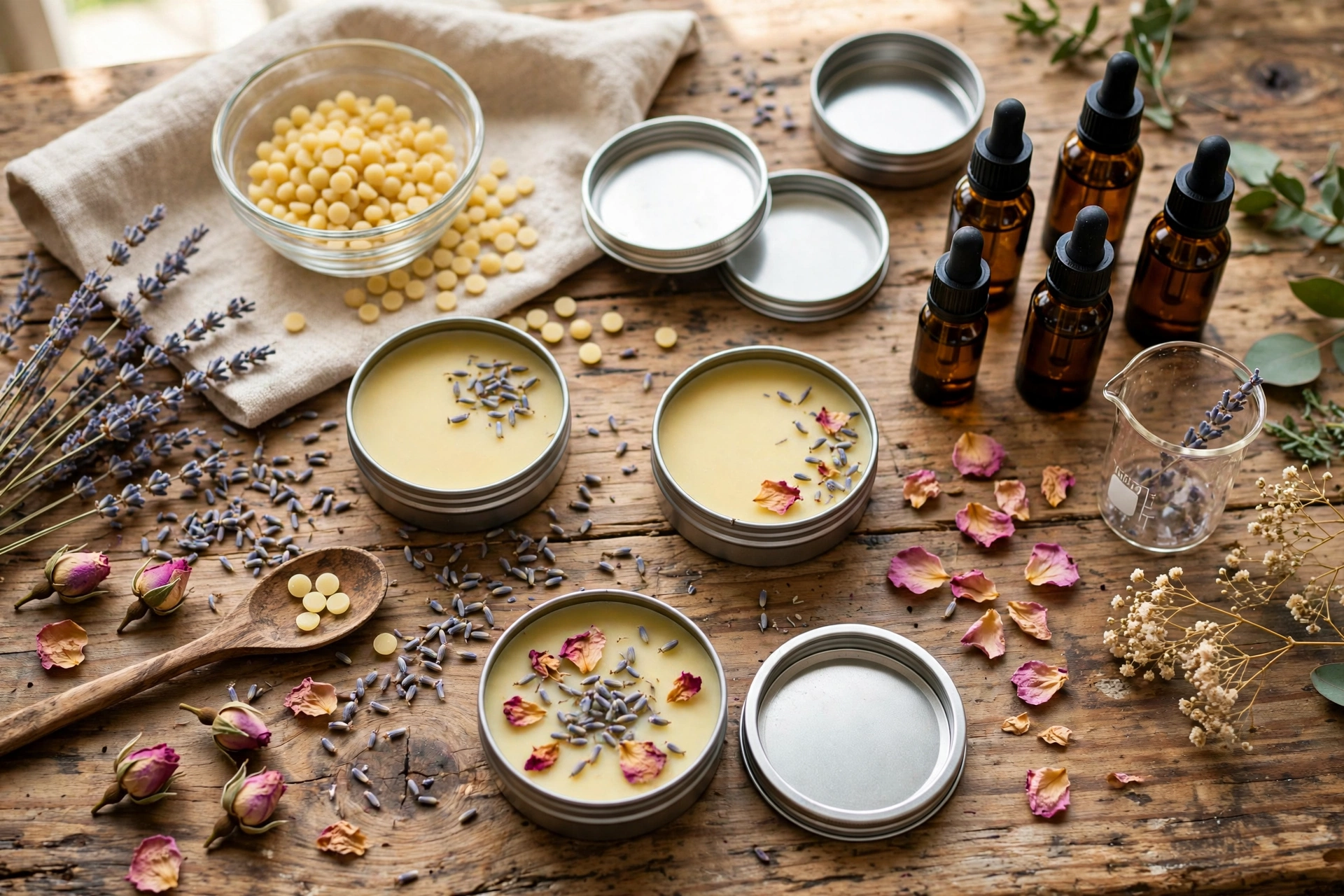
Solid perfume is having a moment — and for good reason. These waxy, portable compacts deliver fragrance without alcohol, sprays, or spills, and making your own lets you create a completely custom scent for a fraction of designer prices. Whether you want a signature scent or a thoughtful handmade gift, here is everything you need to make solid perfume at home.
What Is Solid Perfume?
Solid perfume is fragrance suspended in a wax and oil base instead of alcohol. You apply it by swiping a finger across the surface and dabbing it on pulse points. Compared to spray perfume:
- More portable — no liquid restrictions for flights, no leaking in your bag.
- Gentler on skin — no drying alcohol; the oils actually moisturize.
- More intimate sillage — sits closer to the skin rather than projecting across the room. Great for offices and close encounters.
- Longer-lasting on skin — the wax base slows evaporation, so scent can last 4–6 hours.
The trade-off: less projection than spray, and you need to reapply with fingers (wash hands first if you have been handling food or strong scents).
What You’ll Need
Base ingredients
- Beeswax (1 tablespoon) — the solidifier. Use cosmetic-grade pellets for easy melting. For a vegan version, substitute candelilla wax (use slightly less, as it is harder).
- Carrier oil (1 tablespoon) — jojoba oil is ideal (stable, non-greasy, long shelf life). Sweet almond oil or fractionated coconut oil also work.
- Optional: shea butter or vitamin E oil (1/2 teaspoon) — adds creaminess and acts as an antioxidant to extend shelf life.
Fragrance
- Essential oils (15–20 drops total) — the most accessible option. Quality matters; cheap fragrance oils can irritate skin.
- Perfume-grade fragrance oils — more complex scents than single essential oils, designed for skin safety.
- A small tin or compact — lip balm tins, small mason jars, or empty solid perfume compacts.
The basic ratio is roughly 1:1:1 — equal parts wax, carrier oil, and (by volume, much less) fragrance at 15–20% concentration. This gives a firm-but-spreadable texture.
Step-by-Step Instructions
- Set up a double boiler. Place a heat-safe glass bowl over a pot of simmering water (don’t let the bowl touch the water). This gentle heat prevents scorching.
- Melt the beeswax. Add your beeswax pellets and stir until fully liquid, about 2–3 minutes.
- Add the carrier oil. Pour in jojoba oil (and shea butter/vitamin E if using) and stir until combined and smooth.
- Remove from heat and cool slightly. Let the mixture cool for 1–2 minutes — you want it warm but not steaming. Adding fragrance to overheated oil can degrade delicate top notes.
- Add your fragrance oils. Drop in your essential oil blend and stir gently but thoroughly for 30 seconds to distribute evenly.
- Pour into containers. Work quickly — the mixture starts setting as it cools. Pour into your tins or compacts.
- Let it set. Leave undisturbed at room temperature for 2–3 hours (or 30 minutes in the fridge if you are impatient).
- Cure for 48 hours. Like candles, solid perfume benefits from a short cure — the scent melds and deepens over 2 days.
Creating Your Signature Scent: Blending Basics
Perfumery uses a note pyramid — combine oils from each layer:
- Top notes (first impression, fade in 15–30 min): Bergamot, grapefruit, lemon, peppermint, eucalyptus. Use 3–5 drops.
- Heart/middle notes (the character, last 2–4 hours): Lavender, rose, geranium, ylang-ylang, jasmine, clary sage. Use 6–8 drops.
- Base notes (the foundation, last 4–6+ hours): Vanilla, sandalwood, cedarwood, patchouli, vetiver, frankincense. Use 4–6 drops.
Beginner-friendly blends to try
- Fresh & clean: 4 drops bergamot + 6 drops lavender + 4 drops cedarwood.
- Warm & cozy: 3 drops sweet orange + 5 drops ylang-ylang + 6 drops vanilla.
- Earthy & grounding: 4 drops bergamot + 5 drops clary sage + 5 drops sandalwood.
- Romantic floral: 3 drops grapefruit + 7 drops rose + 4 drops patchouli.
Start with fewer drops — you can always make a stronger batch next time, but you cannot un-add fragrance. Keep notes on your ratios so you can replicate favorites.
Safety and Skin Considerations
- Patch test first. Apply a small amount to your inner forearm and wait 24 hours before wearing a new blend.
- Know phototoxic oils. Citrus oils (bergamot, lemon, lime) can cause sun sensitivity. Use bergaptene-free (FCF) versions or keep citrus to low concentrations if you will be in sun.
- Dilution matters. At 15–20% fragrance in the finished product, most essential oils are safe for skin — but never apply undiluted essential oils directly.
- Pregnancy caution. Some essential oils are not recommended during pregnancy. Check with your doctor if applicable.
The FDA’s fragrance safety information covers labeling requirements and common allergens worth knowing about, even for DIY products.
How to Wear Solid Perfume
Apply to pulse points where body heat diffuses the scent: wrists, behind ears, base of throat, inner elbows. A little goes a long way — one light swipe per point. Reapply every 4–6 hours as needed.
Pro tip: layer your solid perfume over unscented lotion. Moisturized skin holds fragrance significantly longer than dry skin — the same principle behind maintaining an even tan, where hydration is everything.
Storage and Shelf Life
- Store in a cool, dark place — heat melts the wax base and degrades fragrance.
- Properly made solid perfume lasts 1–2 years (jojoba oil’s stability helps).
- If it develops an off or rancid smell, the carrier oil has oxidized — time for a fresh batch.
- Keep the tin closed when not in use to prevent scent evaporation and dust.
Troubleshooting
- Too hard: Too much wax. Remelt and add more carrier oil.
- Too soft/melty: Too much oil. Remelt and add more wax.
- Grainy texture: Cooled too slowly or shea butter crystallized. Remelt fully and cool more quickly.
- Scent too weak: Increase fragrance to 20–25 drops next batch, or add more base notes (they linger longest).
- Scent fades fast: Normal for top-note-heavy blends. Shift your ratio toward heart and base notes.
For more on working safely with essential oils generally, the National Association for Holistic Aromatherapy’s safety guidelines are the gold standard reference.
Frequently Asked Questions
How long does homemade solid perfume last on skin?
Typically 4–6 hours, depending on the oils used (base notes linger longest) and your skin chemistry. Reapply as needed — that is the beauty of the portable format.
Can I use fragrance oils instead of essential oils?
Yes — skin-safe, phthalate-free fragrance oils give you access to scents (like “ocean breeze” or “birthday cake”) that do not exist as essential oils. Just ensure they are labeled safe for skin use.
Is solid perfume good for sensitive skin?
Often better than spray, since there is no alcohol. But fragrance itself can irritate sensitive skin — patch test, keep concentrations moderate, and consider a single-note (like vanilla) blend to minimize allergen exposure.
The Bottom Line
Making solid perfume is a simple, satisfying DIY: melt wax and oil, add your fragrance blend, pour, and let set. The 1:1 wax-to-oil ratio with 15–20 drops of essential oils gives you a professional-feeling product customized entirely to your taste. Experiment with the note pyramid, keep records of blends you love, and enjoy having a signature scent that literally fits in your pocket — a perfect complement to an overall polished, youthful look.



