At-Home Microneedling vs. Pro Treatments: What’s Actually Safe?
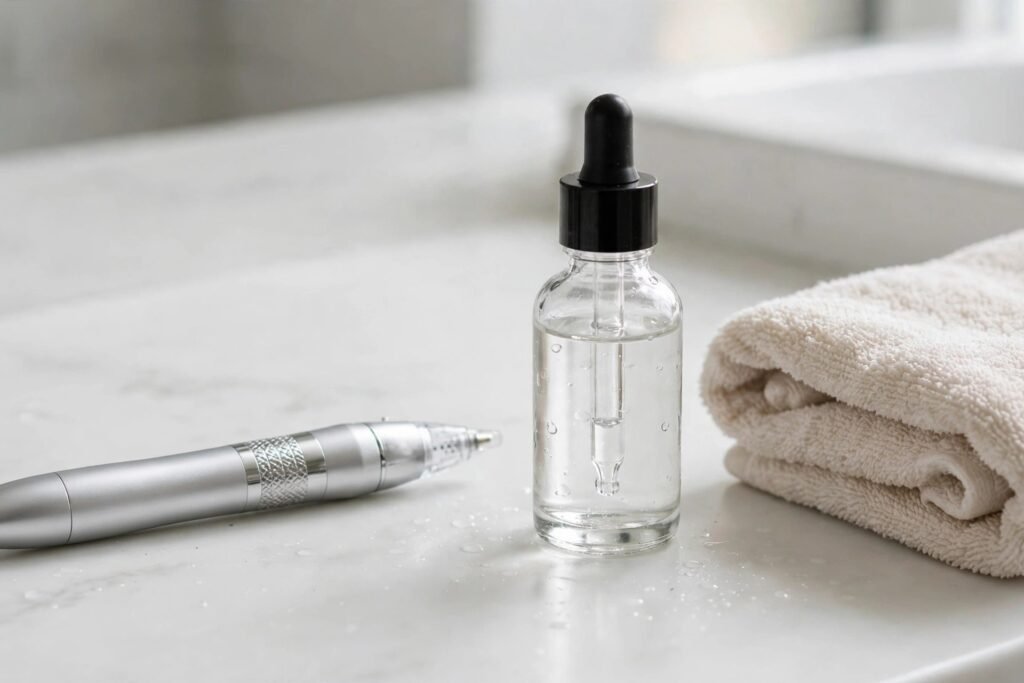
Type “microneedling at home” into any search bar and you will find thousands of glowing reviews, dramatic before-and-after photos, and derma rollers selling for less than the cost of a latte. The promise is seductive: the same collagen-boosting treatment celebrities pay hundreds for, done on your couch for pennies. But dermatologists across America have a more complicated take — and the gap between a safe at-home routine and a risky one comes down to details most product listings never mention.
This article explains what microneedling actually does to your skin, where at-home devices differ from professional treatments, what the real risks are, and how to decide which route makes sense for your skin goals and your budget.
What Microneedling Does to Your Skin
Microneedling — also called collagen induction therapy — uses fine needles to create thousands of microscopic punctures in the skin’s surface. These controlled micro-injuries trigger the body’s wound-healing response: inflammation, then proliferation, then remodeling. During remodeling, fibroblasts produce new collagen and elastin, the proteins that keep skin firm and smooth.
The evidence is genuinely strong for certain concerns. Peer-reviewed studies show microneedling improves atrophic acne scars, fine lines, enlarged pores, and uneven texture. It also dramatically increases the absorption of topical products — serums applied after needling penetrate far more deeply, which is why the treatment pairs so well with hyaluronic acid and vitamin C. According to the American Academy of Dermatology’s overview of microneedling, it is considered safe and effective when performed properly — with “performed properly” doing a lot of heavy lifting in that sentence.
At-Home Devices: What You Are Actually Buying
At-home microneedling tools fall into two categories. Derma rollers — the spiky wheels — use needles typically 0.25mm to 0.5mm long (reputable ones; cheap imports may be mislabeled). Derma stamps and pens press straight down rather than rolling, which is technically better since rolling needles enter and exit the skin at an angle, creating slightly larger, tear-shaped wounds.
Here is the critical distinction: at-home needle lengths are designed to stay in the epidermis, the skin’s outermost layer. They boost product absorption and give a mild glow, but they do not reach the dermis where real collagen remodeling happens. That is not a flaw — it is a safety feature. The dermis is where the meaningful results and the meaningful risks live.
Professional Microneedling: What the Extra Money Buys
In a dermatologist’s office or medical spa, needle depths run 0.5mm to 2.5mm, adjusted by area — deeper on cheeks for acne scars, shallower on the forehead. Professionals also use motorized pens that stamp vertically at high speed, creating clean, uniform channels rather than the angled tears of a roller. Treatments often include medical-grade topicals, and many practices now combine microneedling with platelet-rich plasma (PRP) or radiofrequency for enhanced results.
A single professional session in the US typically costs $200 to $700, and most concerns need three to six sessions. That is real money — but the depth, sterility, and technique are in a different league from a $20 roller. For acne scarring, surgical scars, or significant texture issues, at-home devices simply cannot reach the tissue that needs remodeling. No honest dermatologist will tell you otherwise.
The Real Risks of DIY Microneedling
This is where the cheerful Amazon reviews go quiet. The risks of at-home microneedling are well documented:
Infection. You are puncturing your skin’s protective barrier thousands of times. A roller that is not properly disinfected — or worse, shared — can introduce bacteria and cause infections, including staph. Professionals use single-use sterile needle cartridges; your bathroom counter is not a sterile field.
Improper technique. Pressing too hard, rolling over the same area repeatedly, or using the device on active acne can spread bacteria across the face and worsen breakouts. Rolling over moles, rosacea flares, or eczema patches can cause real damage.
Counterfeit and mislabeled devices. The FDA’s medical device guidance notes that microneedling devices intended to affect skin structure are regulated — but the flood of cheap rollers sold as “beauty tools” exists in a gray zone. Needles may be duller, longer, or dirtier than labeled, and dull needles tear rather than puncture.
Wrong products afterward. Freshly needled skin absorbs everything — including ingredients that should never go on compromised skin, like retinoids, strong acids, or fragranced products. Applying the wrong serum post-treatment can cause severe irritation or chemical burns.
Who Should Never Microneedle at Home
Sit this one out — or see a professional first — if you have active acne or cold sores, rosacea, eczema or psoriasis on the face, a history of keloid scarring, are on blood thinners or isotretinoin (Accutane), have diabetes with poor wound healing, or are pregnant. These are not cautious footnotes; they are the contraindications dermatologists screen for at every consultation. A compromised barrier plus needles is a combination that needs medical supervision, full stop.
If You Do It at Home: The Safe Protocol
For healthy skin with mild concerns — dullness, early fine lines, product absorption — at-home microneedling can be done reasonably safely if you are meticulous:
Stick to 0.25mm for product absorption, or 0.5mm maximum, used no more than once a week (0.25mm can be used more often). Buy from a reputable brand, never share the device, and replace rollers regularly — dull needles are worse than no needles. Disinfect by soaking in 70% isopropyl alcohol for ten minutes before and after each use, then air-dry completely. Start on clean, dry skin, use light pressure, and work in small sections without dragging. Afterward, apply only simple, fragrance-free hydrating serums — hyaluronic acid is the gold standard — and always use sunscreen the next day, since needled skin is temporarily more sun-sensitive.
Support the whole project with good fundamentals: foods that nourish healthy skin provide the building blocks your fibroblasts need, and quality sleep — see tips for falling asleep faster without medication — is when most collagen repair actually happens.
The Cost-Benefit Math, Honestly Done
A quality at-home roller ($30–$60, replaced every couple of months) plus good serums runs maybe $200 a year. One professional course of four sessions can cost $1,000 to $2,800. But compare outcomes, not just prices: for glow and absorption, at-home is a reasonable maintenance tool. For acne scars, deep wrinkles, or stretch marks, at-home devices are spending money on results they physically cannot deliver — the professional treatment is the only one that works, making it the cheaper option per unit of actual result.
Conclusion
At-home microneedling is not a scam, and professional microneedling is not a racket — they are simply different treatments with different capabilities. Short-needle home devices can safely boost glow and product absorption on healthy skin when used with strict hygiene. But anything involving real scarring, texture change, or deeper rejuvenation belongs in professional hands, where sterile technique and proper depth make the difference between remodeling and damage. Be honest about which category your skin goals fall into, respect the contraindications, and never let a bargain price talk you into puncturing compromised skin.
Frequently Asked Questions
How often can I microneedle at home safely?
With a 0.25mm roller, two to three times per week is generally considered safe for healthy skin. With 0.5mm, limit use to once every one to two weeks to allow full recovery between sessions.
Does at-home microneedling actually build collagen?
Minimally. Home needle lengths (0.25–0.5mm) primarily enhance product absorption and surface glow. Meaningful collagen induction requires depths of 1.0mm+, which should only be done by professionals.
Can I microneedle over active acne?
No. Needling over active breakouts can spread bacteria and worsen inflammation, potentially causing new scarring. Wait until breakouts are fully healed, and consult a dermatologist if acne is persistent.
What should I put on my skin after microneedling?
Simple, fragrance-free hydrating products — hyaluronic acid serum is ideal. Avoid retinoids, vitamin C (L-ascorbic acid), AHAs/BHAs, and fragranced products for at least 24–48 hours after treatment.
How do I know if my derma roller is still good?
Replace rollers every 8–10 uses or at the first sign of tugging, scratching, or bent needles. Dull needles tear the skin instead of creating clean micro-channels, increasing irritation and infection risk.