Is Nuclear Energy Actually Safe? The Data Says Yes
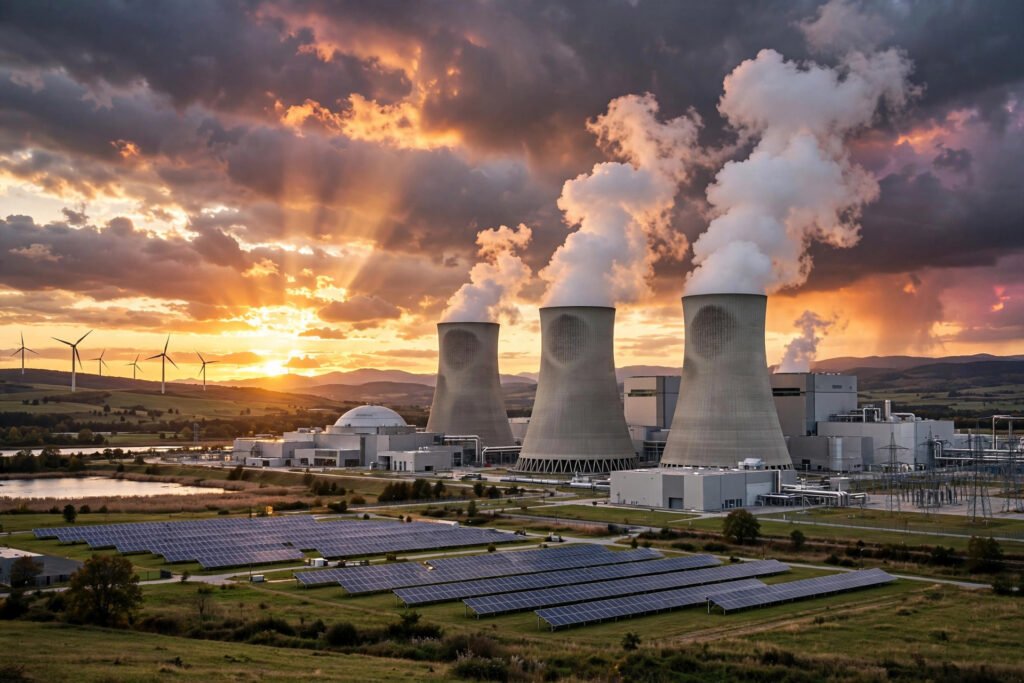
Nuclear energy occupies a strange place in the American imagination: statistically one of the safest energy sources ever deployed, yet widely feared as uniquely dangerous. The gap between perception and data is enormous — and it matters, because nuclear currently provides about half of America’s carbon-free electricity, and debates over its future shape climate policy. So let’s ask the question honestly: is nuclear energy actually safe compared to other sources? The answer, measured in deaths per unit of electricity, accidents per reactor-year, and waste handled, is clearer than the debate suggests.
Measuring Safety: Deaths per Terawatt-Hour
The most objective safety metric is deaths per terawatt-hour (TWh) of electricity generated — it captures the full lifecycle: mining, construction, operation, waste, and accidents. The numbers, compiled from peer-reviewed analyses including data from Our World in Data and the medical journal The Lancet: coal kills about 24.6 people per TWh (air pollution dominates), oil about 18.4, natural gas about 2.8, biomass about 4.6, hydropower about 1.3 (dominated by rare dam failures), wind about 0.04, nuclear about 0.03, and solar about 0.02.
Read that again: nuclear’s death rate per unit of energy is roughly comparable to wind and solar, and roughly a thousand times lower than coal’s. Even including Chernobyl and Fukushima in the accounting, nuclear remains among the safest sources by this measure. The reason is physical: nuclear’s energy density is millions of times greater than chemical fuels, so the entire lifecycle — mining, transport, waste — involves vastly smaller material quantities and fewer exposed workers. Coal’s toll, by contrast, is dominated not by dramatic accidents but by the quiet, continuous toll of air pollution — particulates and smog that kill an estimated tens of thousands of Americans yearly, a toll so diffuse it never makes headlines the way a reactor incident does.
What About Accidents? Chernobyl, Fukushima, Three Mile Island
Intellectual honesty requires confronting the three accidents that define nuclear fear. Chernobyl (1986) was the worst: a flawed Soviet reactor design operated recklessly during a safety test, with no containment structure. The UN’s UNSCEAR assessments attribute around 50 direct deaths plus an estimated few thousand eventual cancer deaths among highly exposed populations — a genuine catastrophe, and one impossible in modern Western reactor designs, which have containment structures and negative safety coefficients Chernobyl lacked.
Fukushima (2011) is the most misunderstood: a 9.0 earthquake plus tsunami overwhelmed the plant, causing meltdowns — yet UNSCEAR’s comprehensive studies found no discernible increase in cancer rates attributable to radiation, and zero radiation deaths. The tragedy was the tsunami (18,000+ dead) and the chaotic evacuation (over 1,000 stress-related deaths) — not the radiation. Three Mile Island (1979), America’s worst commercial accident, released minimal radiation; decades of health studies found no detectable public health impact. The pattern: even the worst accidents in 18,000+ cumulative reactor-years of global operation killed far fewer people than coal kills in a typical month.
Waste: The Real Unsolved Problem (Sort Of)
Nuclear waste is the strongest argument critics have — and it’s weaker than it looks. First, the volume: all of America’s commercial nuclear waste from 60+ years would fill a single football field about 10 yards deep. Coal plants produce that volume of toxic ash every few hours. Second, the hazard decays: high-level waste is most dangerous in the first decades and declines over centuries (the “million-year” framing misleads — after a few hundred years, it’s less radioactive than the original uranium ore was). Third, the technical solution exists: deep geological repositories. Finland’s Onkalo facility is operational; America’s Yucca Mountain was scientifically approved then politically killed — a political failure, not a technical one.
The honest caveats: waste requires institutional stewardship on century timescales, which demands stable governance — a fair concern. And the U.S. currently stores waste on-site at plants, which is safe but inelegant. But “unsolved” overstates it: the physics and engineering are settled; what’s missing is political will. Compared to fossil fuels’ waste — billions of tons of CO2 dumped freely into the atmosphere yearly, plus coal ash ponds that have caused their own environmental disasters — nuclear’s contained, tiny-volume waste stream is arguably the best-managed waste of any energy source.
Proliferation, Terrorism, and the Honest Risks
Two risks deserve serious treatment. Proliferation: civilian nuclear programs can provide cover and expertise for weapons programs — a genuine geopolitical concern, managed through IAEA safeguards and inspections, imperfectly. This is an argument about specific countries and governance, not about physics. Terrorism/sabotage: plants are among the most hardened civilian infrastructure in America, with dedicated security forces, and no successful attack has ever occurred — but the consequence side of the risk equation is real enough that security costs are substantial.
There’s also cost: new nuclear plants in the U.S. have been brutally expensive (Vogtle’s overruns are legendary) — the Department of Energy’s nuclear office tracks advanced reactor designs aiming to change that math., which is an economic argument more than a safety one — though expensive-safe and cheap-dangerous trade-offs are exactly what energy policy must weigh. Small modular reactors (SMRs) promise better economics with enhanced passive safety, and several designs are progressing through NRC licensing in 2026. The U.S. Energy Information Administration publishes detailed data on generation costs and safety records for every source, worth consulting before joining any energy debate.
The Verdict: Safe Compared to What?
Compared to fossil fuels — the sources nuclear would actually replace — nuclear is dramatically safer: hundreds to thousands of times fewer deaths per unit energy, no air pollution, minimal carbon. Compared to renewables, it’s roughly in the same safety league, with different risk profiles (tiny-probability/high-salience accidents versus diffuse manufacturing and installation risks). The rational fear ranking, by data, runs: coal and oil (by far the deadliest), then gas and biomass, then hydro, then nuclear/wind/solar clustered at the bottom.
Fear of nuclear is psychologically understandable — radiation is invisible, accidents are cinematic, and dread risks feel worse than familiar ones (nobody fears coal plants despite the body count). But energy policy built on dread rather than data keeps the deadliest sources running longer. Whatever America’s energy mix becomes, it should be chosen with the numbers in view — and the numbers say nuclear belongs in the conversation as one of the safest options available. For households, the parallel lesson is efficiency: energy-efficient home upgrades and winter efficiency measures cut demand regardless of which source supplies it — the cleanest kilowatt-hour is the one you never use.
Conclusion
Is nuclear energy actually safe compared to other sources? By the hard metric of deaths per unit of electricity, yes — it’s among the safest sources ever deployed, roughly a thousand times safer than coal and comparable to wind and solar, even counting Chernobyl and Fukushima. The real challenges are waste stewardship (technically solved, politically stuck), proliferation governance, and cost — serious issues, but different from the safety question. Judge energy sources by their measured tolls, not their feared ones, and nuclear earns its place in a clean, safe energy future.
Frequently Asked Questions
How many people have died from nuclear power accidents?
Chernobyl caused around 50 direct deaths plus an estimated few thousand eventual cancer deaths among the most exposed. Fukushima caused zero radiation deaths. Three Mile Island caused none. Across 18,000+ reactor-years globally, nuclear’s total accident toll is far below what coal’s air pollution kills in a single year.
Is nuclear waste really dangerous for a million years?
This framing misleads. High-level waste is most hazardous in its first decades and decays substantially over centuries; after several hundred years it’s less radioactive than natural uranium ore. Deep geological repositories (like Finland’s operating Onkalo) isolate it safely — the barrier is political, not technical.
Could an American reactor explode like Chernobyl?
No. Chernobyl’s RBMK design had a positive void coefficient (power surges when cooling is lost) and no containment structure — flaws no Western commercial reactor shares. U.S. reactors have massive containment buildings and designs where power drops when cooling is lost. A Chernobyl-type event is physically impossible in them.
Why is nuclear power so expensive to build in the U.S.?
A combination of first-of-a-kind designs, regulatory ratcheting, loss of construction expertise during the decades-long build hiatus, and financing costs on decade-long projects. Countries that build standardized designs repeatedly (South Korea, China) build far cheaper. Small modular reactors aim to fix this with factory-built standardized units.