When Should You Replace Car Tires? Safety Signs to Know
Tires are the only part of your car that touches the road, yet they’re the maintenance item American drivers postpone most. The statistics are sobering: the National Highway Traffic Safety Administration estimates that hundreds of fatalities each year involve tire-related crashes, and a huge share trace back to worn, underinflated, or aged-out tires. The tricky part is that tires rarely fail without warning — they broadcast their condition for months. You just have to know how to read the signals. Here’s exactly when to replace your tires for safety, and how to tell the difference between tires with life left and tires that are gambling with your family.
Tread Depth: The Quarter Test and the Legal Minimum
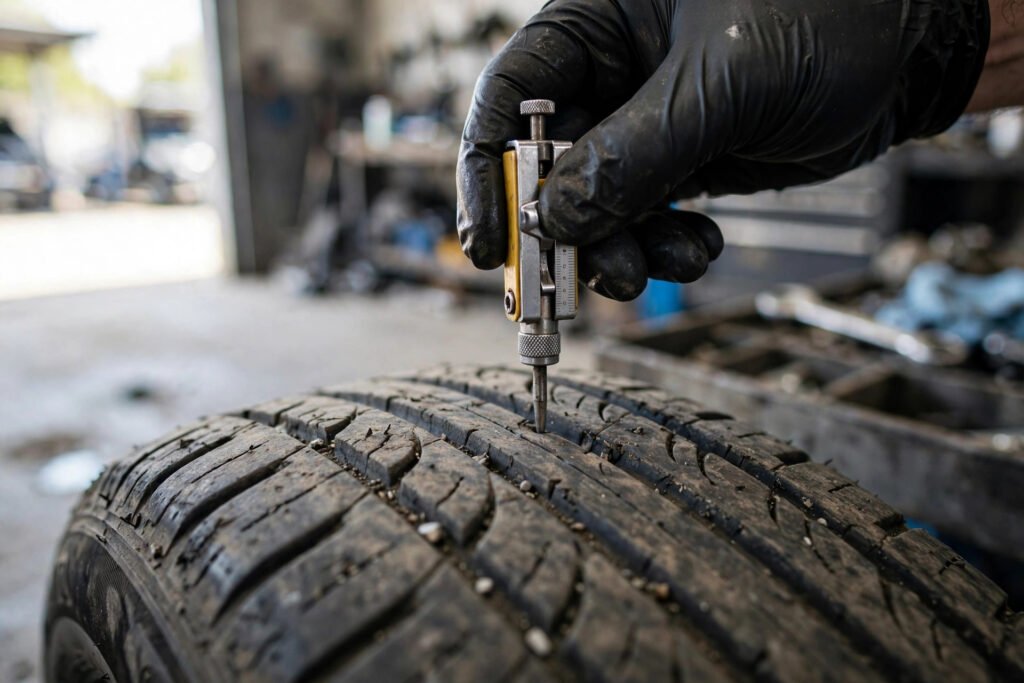
Tread channels water away from the contact patch — without enough depth, your car hydroplanes. Most states set the legal minimum at 2/32 of an inch, and tires have built-in wear bars at exactly that depth: when the tread surface is flush with those little raised bars between the grooves, the tire is legally done.
But legal and safe aren’t the same thing. Tire safety testing consistently shows that wet-weather stopping distances grow dramatically once tread drops below 4/32 of an inch. The practical rule: at 4/32″, start shopping; at 2/32″, replace immediately. The classic penny test (Lincoln’s head visible = replace) measures 2/32″; the quarter test (Washington’s head visible = time to shop) measures 4/32″ and is the smarter threshold. The National Highway Traffic Safety Administration publishes tire safety guidance that reinforces this margin-based approach. Consumer Reports tire ratings also rank current models by wet braking and treadwear when you’re comparison shopping.
Age Matters Even When Tread Looks Fine
Here’s what surprises most drivers: tires expire. Rubber compounds degrade through oxidation and heat cycling whether the tire is rolling or sitting in a garage. Most manufacturers recommend replacing tires at six years from the manufacture date, regardless of tread depth, and virtually all agree ten years is the absolute maximum.
Check the DOT code on the sidewall — the last four digits show the week and year of manufacture (e.g., “3221” means the 32nd week of 2021). That low-mileage spare or the tires on the garage-kept classic may look pristine and still be dangerously aged. Heat accelerates the process, so tires in Phoenix or Miami age faster than tires in Minneapolis.
Damage and Wear Patterns That Mean “Replace Now”
Some conditions don’t wait for a tread measurement:
Sidewall bulges, cuts, or cracks
A bulge means the internal structure has failed — the tire can blow out without further warning. Sidewall damage is never repairable; replace the tire immediately and don’t drive on it except to reach a shop, slowly.
Uneven wear
Wear concentrated on the inner or outer edge signals alignment problems; center wear suggests chronic overinflation; patchy cupping points to suspension issues. The tire may need replacing, but fix the underlying cause first or you’ll destroy the new set the same way.
Vibration or pulling
New vibrations at highway speed can indicate internal tire damage, a slipped belt, or balance problems. Get it inspected promptly — internal separations can fail catastrophically.
Frequent pressure loss
A tire that needs air every week has a slow leak, a failing valve stem, or bead damage. Beyond the annoyance, underinflation is the number one cause of heat-related blowouts.
Tire Maintenance Habits That Extend Tire Life
Replacement timing matters, but maintenance determines how soon that day arrives. Four habits add thousands of miles to a set of tires:
Monthly pressure checks. Underinflation is the silent tire killer — it increases flexing, heat buildup, and edge wear, and it’s implicated in a huge share of tire-related failures. Check pressures cold (before driving) against the door jamb sticker, not the sidewall maximum. Tires lose about 1 PSI per month naturally, and every 10°F temperature drop costs another PSI — which is why the first cold snap of fall always triggers dashboard warning lights.
Rotation every 5,000–8,000 miles. Front and rear tires wear differently (fronts handle steering and most braking). Regular rotation evens wear across all four, extending the set’s life by thousands of miles. Most shops rotate for $20–$40, and many include it free with oil changes — there’s no excuse to skip it.
Alignment checks. Hitting a major pothole or curb can knock alignment out, causing rapid uneven wear that destroys tires in months. If the car pulls or the steering wheel sits crooked, get an alignment check — a $100 alignment saves a $600 tire set.
Visual inspections. Once a month, walk around the car and look: embedded nails or screws (often repairable if in the tread, never in the sidewall), cracking between tread blocks (dry rot, common on low-mileage cars with old tires), and uneven wear patterns that signal alignment or suspension issues. Five minutes monthly catches problems while they’re cheap.
Seasonal Timing: When to Make the Switch
If you run dedicated winter tires, the swap timing matters. Winter tire compounds stay pliable below about 45°F; all-seasons harden and lose grip. The rule of thumb used across the northern states: install winters when temperatures consistently drop below 45°F, remove them when spring temperatures consistently exceed it — running soft winter rubber through summer heat wears it out fast.
For everyone else, late fall is the ideal replacement window: you head into the most dangerous driving season on fresh rubber. And if you’re gearing up for holiday travel, planning a budget road trip should always start with a tire check — a blowout in rural nowhere is the most expensive possible way to learn your tires were done.
Choosing Replacements: What Actually Matters
Match the size, load index, and speed rating on your door jamb sticker — not the tire sidewall, which only shows what’s currently mounted. Beyond that, prioritize in this order: wet traction ratings, treadwear warranty, noise, then price. The cheapest tire that meets your size spec is rarely the cheapest per mile; a $140 tire lasting 60,000 miles beats a $90 tire lasting 30,000. Replace in axle pairs at minimum — and on all-wheel-drive vehicles, many manufacturers require all four to match within tight tread-depth tolerances, or you risk expensive drivetrain damage. Winter driving brings its own prep list, and weatherproofing for winter pairs naturally with a fresh set of cold-weather-capable tires.
Conclusion
Replace your tires when tread hits 4/32 of an inch (start shopping) to 2/32 (immediately), when they hit six years of age regardless of appearance, or the moment you spot sidewall damage, bulges, or severe uneven wear. These aren’t arbitrary numbers — they’re the thresholds where physics turns against you in wet weather and emergency maneuvers. Tires are the cheapest life-insurance policy your car offers; don’t let a $600 set of rubber be the reason for a crash that costs infinitely more.
Frequently Asked Questions
How many miles do tires typically last?
Most quality all-season tires last 40,000 to 70,000 miles depending on compound, driving style, and maintenance. Check your tread depth regularly rather than relying on mileage alone.
Can I replace just one tire?
On front- or rear-wheel-drive cars you can usually replace in pairs on the same axle. On all-wheel-drive vehicles, mismatched tread depths can damage the drivetrain — many manufacturers require replacing all four.
Do I really need winter tires?
If winter temperatures in your area regularly stay below 45°F, yes — winter compounds grip dramatically better on cold pavement, not just snow. All-seasons are a compromise; winters are a specialization.
How often should I check tire pressure?
At least monthly and before long trips, measured cold (before driving). Tires lose roughly 1 PSI per month naturally, plus about 1 PSI for every 10°F temperature drop.
Are expensive tires worth it?
Often yes on a cost-per-mile basis. Premium tires typically offer better wet traction and longer treadwear warranties, which matters more for safety than the upfront price suggests.