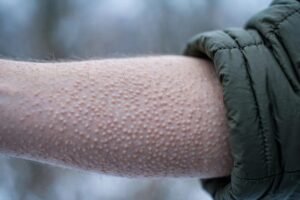
Goosebumps Explained: Why Cold and Fear Raise Tiny Bumps
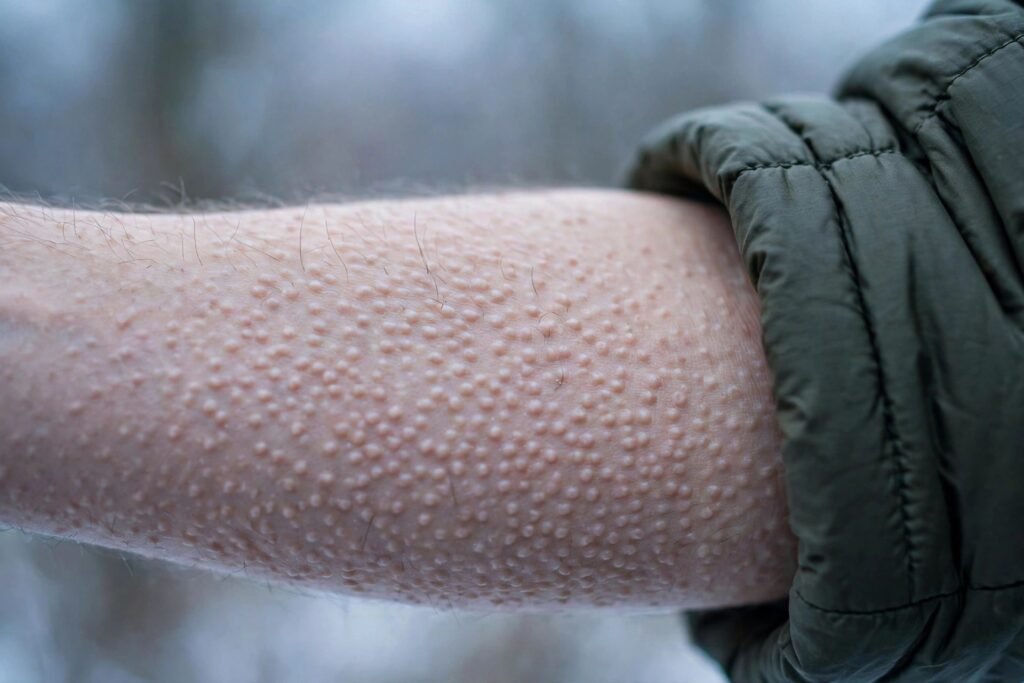
Stepping out into a cold wind, you feel the tiny hairs on your arms stand up and your skin erupt into bumps. Watching a horror movie, the same thing happens at the scary part — though you are perfectly warm. Goosebumps are one of the body’s most visible reflexes, and one of the most puzzling: why would evolution preserve a response that seems to do nothing for modern humans? The answer is a fascinating story of ancient survival machinery still running in a body that no longer needs it.
This guide explains the biology of goosebumps, why both cold and fear trigger them, and what they reveal about our evolutionary past.
The Mechanism: What’s Actually Happening in Your Skin
Each hair on your body sits in a follicle anchored by a tiny muscle called the arrector pili (Latin for “hair erector”). When the sympathetic nervous system — the fight-or-flight branch — fires, these muscles contract, pulling each hair upright and dimpling the surrounding skin into the characteristic bump. The entire process is involuntary: you cannot give yourself goosebumps by trying (though some people can trigger them through vivid emotional recall).
The reflex arc is fast and automatic: sensory input (cold receptors in the skin, or emotional processing in the brain) → sympathetic activation → adrenaline release → arrector pili contraction. The National Institutes of Health (NIH) funds ongoing research into these autonomic emotional responses. It is the same system that dilates your pupils and quickens your pulse — goosebumps are fight-or-flight made visible on your skin. Dermatology references from the American Academy of Dermatology (AAD) describe the arrector pili as part of the skin’s integrated response to environmental and emotional stimuli.
Why Cold Triggers It: The Insulation Story
The cold trigger is the original purpose. In furry mammals, erect hairs trap a thicker layer of still air against the skin — and still air is an excellent insulator. A puffed-up cat, a bristling dog, a fluffed bird: all are maximizing their insulation layer. The piloerection reflex also slightly reduces skin surface exposure and can trigger shivering thermogenesis as a companion response.
Humans retain the reflex but lost the fur. With our sparse body hair, erect hairs trap essentially no meaningful air layer — the insulation effect is negligible. We are running ancestral software on hardware that no longer supports it: the signal fires, the muscles contract, and nothing useful happens. It is a vestigial reflex — like the appendix or wisdom teeth, a leftover from an evolutionary past when it mattered enormously. Our ancestors, covered in hair, genuinely stayed warmer through this response; we just get the bumps.
Why Fear (and Awe) Trigger It: The Intimidation Story
The fear trigger has a parallel evolutionary logic: appearing bigger. A cat arching with raised fur, a dog with hackles up, a porcupine bristling — piloerection makes animals look larger and more threatening to predators or rivals. In our furry ancestors, fear-induced piloerection was a defense display: look big, look dangerous, avoid the fight.
But modern goosebumps are not only about fear — they are famously triggered by awe, music, and emotion: the chill down your spine at a powerful song, a moving speech, a breathtaking vista. Research on “musical frisson” (the technical term for these chills) finds it correlates with openness to experience and involves the brain’s reward circuitry — dopamine release in the nucleus accumbens, the same region activated by food, sex, and drugs. The leading theory: the ancient threat-detection circuitry misfires (beautifully) in response to intense emotional stimuli — pattern-matching the intensity of the feeling to situations where piloerection was useful. Your brain feels something powerful and reaches for its oldest physical expression of intensity.
This emotional dimension connects to broader questions of how the brain processes emotion and stress — the same ancient circuits surface in dreams, fear, and aesthetic rapture alike.
The Physiology in Detail: Cold vs. Emotion Pathways
The two triggers converge on the same muscles through different routes. Cold pathway: thermoreceptors in the skin detect dropping temperature → signals to the hypothalamus (the brain’s thermostat) → sympathetic activation → arrector pili contraction, usually accompanied by vasoconstriction (blood pulled from skin, hence the pallor) and potentially shivering. This is pure thermoregulation — ancient, automatic, shared with all mammals.
Emotion pathway: the amygdala and related emotional centers process the intense stimulus → sympathetic arousal → the same arrector pili contraction, often accompanied by the other fight-or-flight signatures (heart rate changes, pupil dilation, adrenaline). The muscles cannot distinguish why the sympathetic system fired — cold, fear, awe, or a perfect guitar solo all produce the same bumps. This is why the sensation feels so similar across wildly different causes: it is the same response.
Do Goosebumps Do Anything Useful in Humans?
Mostly, no — but “mostly” has interesting exceptions. The insulation effect is negligible with our hairlessness. The intimidation effect is negligible (upright arm hairs do not frighten anyone). However: goosebumps reliably signal sympathetic arousal, making them a visible biomarker of emotional or physiological state — useful to observers, from doctors to poker opponents. Some research suggests the response may slightly enhance tactile sensitivity (erect hairs as extended sensors), though the effect is minor.
The most interesting “use” may be social: visible goosebumps communicate emotional intensity to others — “this moved me” made flesh. In a social species, broadcasting genuine emotional responses builds connection and trust. Your ancestors’ useless-warmth reflex may have been repurposed as an honesty signal: you cannot fake goosebumps, so they are credible evidence of feeling.
When Goosebumps Might Signal Something Medical
Ordinary goosebumps need no attention. But persistent, unexplained piloerection — especially with other autonomic symptoms (sweating abnormalities, heart rate changes, temperature dysregulation) — can rarely indicate autonomic nervous system disorders, and goosebumps with fever/chills patterns warrant evaluation for infection. Supporting immune health also helps regulate the same autonomic-immune interactions involved in frequent illness. When in doubt about unusual symptoms, see a doctor — but everyday goosebumps are simply your evolutionary heritage showing.
Conclusion
We get goosebumps when cold or scared because we inherited a mammalian reflex with two ancient jobs: erecting fur for insulation against cold, and erecting fur for intimidation against threats. Humans kept the reflex but lost the fur, leaving a visible response with no modern function — except the beautiful accident of emotional chills, where our oldest survival circuitry expresses awe, fear, and musical transcendence through the same tiny muscles. Every goosebump is a message from deep evolutionary time: your body remembering, for a moment, what it was like to be a furry mammal in a dangerous, cold world. It does not keep you warm or scare your enemies anymore. But it still tells the truth about what you feel.
Frequently Asked Questions
Why do I get goosebumps when I’m not cold?
Emotional goosebumps come from sympathetic nervous system arousal — the fight-or-flight response triggered by fear, awe, music, or intense emotion. The arrector pili muscles cannot distinguish the trigger; any strong sympathetic activation produces the same bumps.
Are goosebumps useful for humans?
Not really anymore — they are a vestigial reflex from when our ancestors had full fur coats (for insulation and intimidation displays). They persist because they are harmless, though they may serve as honest social signals of emotional intensity.
Why does music give me chills?
“Musical frisson” involves dopamine release in the brain’s reward circuitry, triggered by unexpected harmonies, crescendos, or emotional peaks. People high in openness to experience report it most. The ancient threat-arousal system essentially misfires in response to aesthetic intensity.
Can you control goosebumps voluntarily?
Generally no — it is an autonomic reflex. A small number of people can trigger piloerection through vivid emotional imagery or focused attention, but this is rare and not truly “voluntary” in the normal sense.
Do animals get goosebumps?
The equivalent — piloerection — is universal in furry mammals and serves real functions: insulation (fluffed fur traps air) and threat display (raised hackles look bigger). Birds fluff feathers for the same insulation reason. Humans are the odd ones out: the reflex without the fur.