Pickleball Rules for Total Beginners (US Guide)
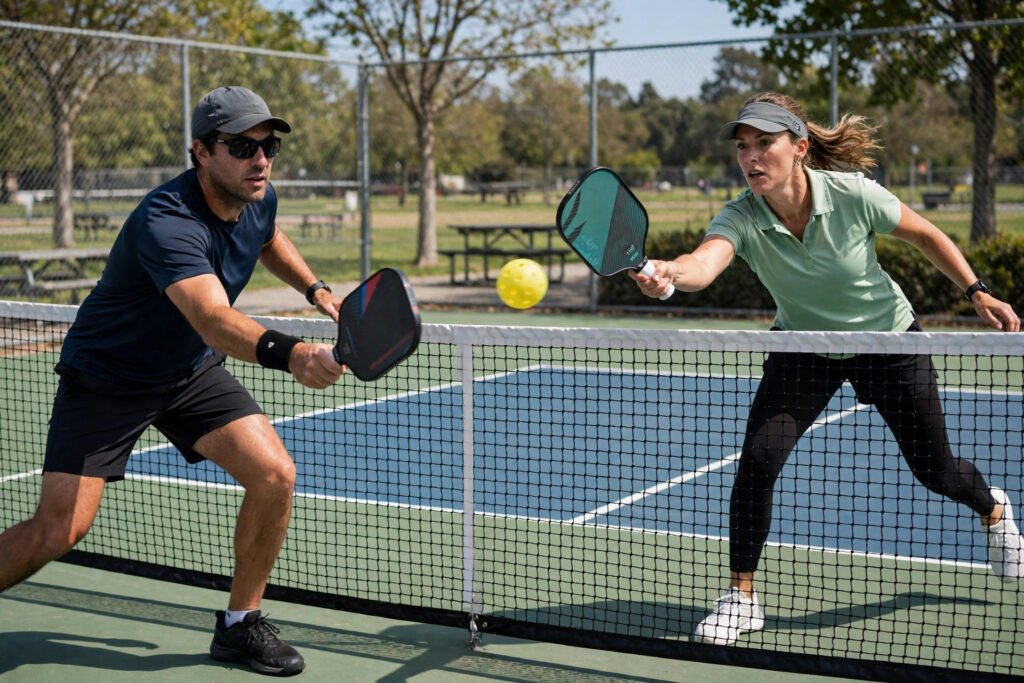
Pickleball is the fastest-growing sport in America — the Sports & Fitness Industry Association has tracked participation exploding past 13 million players, with courts sprouting in parks, YMCAs, and converted tennis facilities from Florida to Washington. If your friends, neighbors, or coworkers keep inviting you to “just come hit,” this guide will get you from confused to competent before your first game.
Pickleball looks like tennis shrunk down and simplified, and that’s roughly right: a badminton-sized court, a perforated plastic ball, and solid paddles. But the rules have quirks — the kitchen, the double-bounce rule, the scoring — that trip up every beginner. Learn them here, and you’ll walk onto the court knowing more than half the people already playing.
The court and equipment basics
A pickleball court is 20 feet wide by 44 feet long — the same dimensions as a doubles badminton court, about a quarter the area of a tennis court. The net hangs 36 inches high at the sidelines and 34 inches at center. Courts are divided by the net into two service areas, each with a left (even) and right (odd) service box.
The critical feature is the “kitchen” — officially the non-volley zone — a 7-foot area on each side of the net, marked by a line. You cannot hit the ball out of the air (volley) while standing in the kitchen, and your momentum can’t carry you into it after a volley either. This single rule shapes the entire sport: it prevents smash-dominated net play and creates the soft, strategic “dinking” game pickleball is famous for.
Equipment is refreshingly cheap by racket-sport standards. A decent beginner paddle costs $40–80 in the US (look for a wide-body composite paddle around 7.5–8 ounces), pickleballs cost a few dollars each, and court shoes with lateral support matter more than most beginners expect.
Scoring: the part everyone fumbles
Pickleball uses rally scoring’s quirky cousin: only the serving team can score points. Games go to 11, win by 2. The score is called as three numbers — server’s score, receiver’s score, then the server number (1 or 2). So “4-2-1” means: serving team has 4, receiving team has 2, and this is the first server.
Here’s the twist: in doubles, both partners get to serve (except the very first serve of the game), which is why the third number exists. When the serving team faults, the serve passes to the partner (“second server”), and only when both have faulted does the serve go to the other team — called a “side out.” At the start of the game, the serving team gets only one serve before side-out, so the opening score call is “0-0-2.” It sounds complicated; after three games it’s automatic.
Serving rules
The serve must be hit underhand, with the paddle below the waist and the ball struck below waist level (the “drop serve” alternative — dropping the ball and hitting it after the bounce — is also legal and easier for beginners). The serve must land in the diagonally opposite service box, clearing the kitchen entirely — a serve landing in the kitchen is a fault.
One more quirk: the served ball must bounce before the returner hits it, and then the serve must bounce before the serving team hits the third shot. This is the famous “double-bounce rule” (now officially the “two-bounce rule”): both teams must let the ball bounce once on the first two shots of every rally. After that, volleys are legal everywhere except the kitchen. The rule exists to neutralize the server’s advantage and extend rallies — and forgetting it is the most common beginner fault in American rec play.
The kitchen: detailed rules
The non-volley zone deserves its own section because kitchen faults decide rec games constantly. The rules:
- You may never volley (hit out of the air) while any part of your body touches the kitchen or its line — including the line itself.
- You may stand in the kitchen anytime; you just can’t volley from there. Step in to hit a ball that bounced, step out, all legal.
- Momentum matters: if your volley follow-through carries you into the kitchen, it’s a fault even if the ball is long gone.
- Your paddle, hat, or anything you’re wearing touching the kitchen during a volley is a fault.
The strategic result: the best pickleball is played in a patient “dink” rally — soft shots arcing just over the net into the opponent’s kitchen — until someone pops a ball up high enough to attack. Beginners who try to smash everything lose to patient dinkers every time.
Faults and the flow of a rally
A rally ends — a fault — when: the ball lands out of bounds, the ball bounces twice on one side, a volley is hit from the kitchen, the two-bounce rule is violated, the serve lands in the kitchen or out of the service box, or a player, paddle, or clothing touches the net. Lines are in — if the ball touches any part of a boundary line, it’s good (except the kitchen line on serves, where it’s a fault).
After a fault by the serving team, play passes per the doubles rotation described above. In singles, it’s simpler: fault, and the serve goes to your opponent. Singles pickleball is a serious cardio workout on a small court — arguably the best fitness value in the sport.
Beginner strategy: what actually wins rec games
Forget power. The three skills that win beginner games in America:
- Get to the kitchen line. After the return of serve, move forward to just behind the kitchen line. The team controlling the kitchen line wins the point the majority of the time. Beginners who camp at the baseline get picked apart.
- Serve deep, return deep. Deep serves push returners back; deep returns give you time to reach the kitchen line. Both are high-percentage, low-risk shots.
- Dink with purpose. Aim dinks at your opponent’s feet or backhand side, keep them low over the net, and wait. Patience beats power until roughly the 3.5 skill level.
Protect your joints as you play more: pickleball’s stop-start lateral movement is surprisingly demanding on knees and balance. Our guide to the best exercises for people with bad knees is worth reading if your knees complain after sessions, and improving your balance as you get older pays direct dividends in dink rallies.
Court etiquette for American rec play
Rec pickleball runs on unwritten rules: call the score clearly before every serve, call “out” balls loudly and honestly on your side (opponents’ calls stand — never argue), rotate off after games when players are waiting (most venues use a paddle-rack queue system), and introduce yourself to new players. The sport’s culture is famously welcoming — the fastest way to get invited back is to be pleasant, call lines fairly, and not smash balls at beginners’ faces.
Conclusion
Pickleball’s rules boil down to a handful of quirks: the kitchen you can’t volley from, the two-bounce rule that opens every rally, underhand serves, and scoring where only servers score. Learn those, show up with court shoes and a $60 paddle, and you’ll be rallying within an hour and winning rec games within a month. America’s fastest-growing sport earned that title by being genuinely easy to start — now you know enough to start right. For authoritative guidance, see the USA Pickleball official rules and the YMCA pickleball programs.
Frequently Asked Questions
What is the kitchen in pickleball?
The kitchen (non-volley zone) is the 7-foot area on each side of the net. You cannot hit the ball out of the air while standing in it, though you can stand in it and hit balls that have bounced. It prevents dominant net smashing and creates pickleball’s signature soft “dinking” game.
What is the double-bounce rule in pickleball?
Each team must let the ball bounce once on the first two shots of a rally: the return of serve must bounce, and the serving team’s third shot must also bounce. After that, volleys are allowed (except from the kitchen).
How does scoring work in pickleball?
Only the serving team scores. Games go to 11, win by 2. The score is called as three numbers: server’s score, receiver’s score, server number (1 or 2). In doubles, both partners serve before a side-out, except the game’s first serve.
What equipment does a pickleball beginner need?
A wide-body composite paddle ($40–80), outdoor pickleballs, and court shoes with lateral support. That’s genuinely it — most US parks and YMCAs provide nets, and many have loaner paddles for first-timers.
Is pickleball hard on knees?
It can be — the sport involves frequent lateral cuts and stop-starts. Court shoes (not running shoes), proper warm-ups, and strengthening the muscles around the knee significantly reduce risk. Players with existing knee issues should start with doubles, which covers less court per player.