Improve Your Tennis Serve Power and Accuracy
Watch a big server at your local club — the ball explodes off the racket, kicks sideways, and the returner is lunging before it even lands. Then watch a beginner serve: a tentative toss, a patting motion, and a ball that barely clears the net. The serve is the one shot in tennis you completely control, which makes it both the easiest shot to practice and the most technical to master. Power and accuracy aren’t gifts — they’re mechanics.
This guide breaks down the serve into trainable components: the kinetic chain that generates real power, the toss that makes or breaks everything, the spin variations that create accuracy, and the practice structure that actually transfers to matches. Whether you’re playing USTA league or weekend doubles at the park, these are the levers that matter.
Power comes from the ground up, not the arm
The biggest misconception in recreational tennis: serving power comes from a strong arm. Biomechanical studies of elite servers show the truth — the serve is a full-body kinetic chain. Energy flows from the legs driving up, through hip and trunk rotation, into shoulder rotation, elbow extension, and finally wrist snap (pronation). The arm contributes a surprisingly small fraction of total racket-head speed; it’s the last link, not the engine.
What this means for your practice: if your serve lacks pace, the fix is almost never “swing harder with your arm.” Check the chain from the bottom. Are you bending your knees and driving up into the ball? Are your hips and shoulders rotating sequentially, or is everything moving as one stiff block? The classic drill: practice serves from your knees. With the legs removed, you’ll feel exactly how little power the arm alone produces — and when you stand back up, you’ll start using your legs instinctively. Building the underlying strength helps too; a home-based strength program for beginners covering legs, core, and shoulders directly supports serve development.
The toss: the 80% you can fix today
Ask any teaching pro what ruins most recreational serves and you’ll hear one word: toss. An inconsistent toss forces your body to adjust mid-motion, destroying timing, balance, and power. The toss should be:
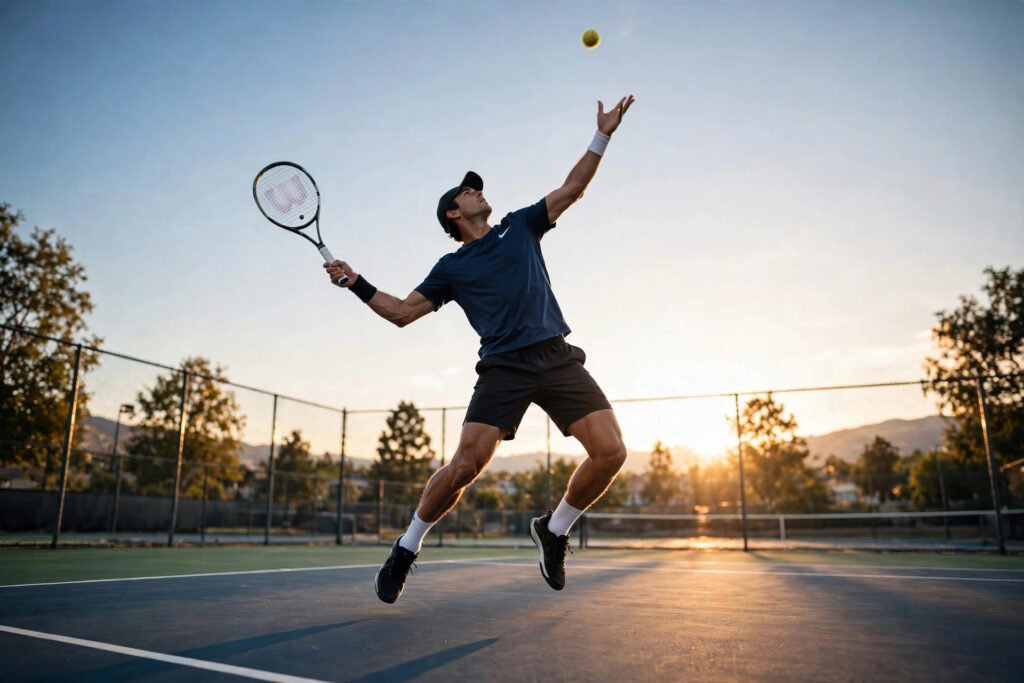
- Straight up, minimal spin: release the ball from your fingertips around eye level, lifting — not throwing — it upward. The ball should peak roughly 6–12 inches above your maximum reach.
- Consistent placement: for a flat serve, the toss sits slightly in front and to the right (for right-handers) of your front shoulder; for kick serves, more above or behind the head. Pick one target spot and groove it.
- High enough to complete the motion: a low toss rushes the swing; most beginners toss too low, not too high. When in doubt, toss higher.
- Released with a straight arm: the tossing arm goes up like a flagpole, then tucks into your chest as you swing — the “trophy pose” checkpoint coaches look for.
The practice: stand at the service line and toss 50 balls without hitting them, catching each at its peak with your racket hand. Boring? Yes. Transformative? Completely. A reliable toss is the single fastest serve upgrade available to most American rec players.
Pronation: the wrist snap that isn’t a snap
“Snap your wrist” is the most common — and most misunderstood — serving advice. What elite servers actually do is pronation: the forearm rotates so the palm turns from facing sideways to facing down through contact. It looks like a wrist snap but it’s a forearm rotation, and it’s responsible for the last burst of racket-head speed plus the spin that brings serves down into the box.
The safe way to learn it: the “throw the racket” drill. Take an old racket (or just your hand), stand sideways, and practice throwing motions where your arm naturally pronates — exactly like throwing a football or baseball. Your body already knows pronation from throwing sports; the serve just channels it upward. Never force wrist flexion — that’s how wrist injuries happen. Posture through the motion matters as well; see improving posture while working at a desk for the thoracic mobility work that frees up the serving shoulder.
Spin is accuracy: flat, slice, and kick
Beginners think of the serve as one shot. Competitive players think of it as three, chosen by situation:
Flat serve: minimal spin, maximum pace, aimed at the corners. Highest risk, highest reward — your first-serve weapon when it’s on, your double-fault machine when it isn’t.
Slice serve: sidespin that curves the ball sideways and skids low off the court. The wide slice in the deuce court (for right-handers) pulls returners off the court and opens the whole court for your next shot. Easier to control than flat, and devastating at the rec level.
Kick (topspin) serve: heavy topspin that makes the ball jump up high off the bounce. The safest serve in tennis — the spin pulls the ball down into the box, giving you margin for error. Every player needs a reliable kick or topspin second serve; players whose second serve is just a slower flat serve donate double faults.
The accuracy framework: aim first serves at big targets (the corners with margin), and second serves with heavy spin to safe targets (the middle of the box, deep). The math of serving: a 60% first-serve percentage with an 85% second-serve win rate beats a 40% first-serve percentage with bombs, at every level below professional.
The practice structure that transfers to matches
Most players “practice” serves by hitting a basket of balls with no structure, then wonder why matches feel different. Structured serve practice:
- Warm up the motion with 10–15 shadow swings and half-speed serves — never go full pace cold.
- Block practice: 20 serves to the deuce court wide, 20 to the T, 20 ad court wide, 20 ad T. Groove each target separately.
- Random practice: call the target before each serve, alternating randomly. This simulates match decision-making and transfers far better than blocked repetition.
- Pressure practice: play serving games — e.g., you must make 7 of 10 second serves, or restart. Matches are pressure; practice should include it.
- Track it: first-serve percentage and double faults per set, every match. What gets measured gets improved.
Twenty focused minutes, three times a week, beats a monthly hour-long basket session. The serve responds to frequency more than volume.
Conclusion
Serve power comes from the legs and the kinetic chain, not the arm. Accuracy comes from a consistent toss and spin variation, not from aiming smaller. Practice with structure — blocked targets, then random targets, then pressure — and track your percentages. Do that for a season, and your serve goes from the shot you survive to the weapon you build points around. For authoritative guidance, see the USTA serve technique resources and the ITF rules of tennis.
Frequently Asked Questions
How can I add power to my tennis serve?
Drive up with your legs, rotate hips then shoulders sequentially, and pronate through contact. Most rec players arm the ball — fixing the kinetic chain from the ground up adds more pace than any grip or racket change.
Why is my tennis toss so inconsistent?
You’re probably throwing rather than lifting the ball. Release from the fingertips around eye level with a straight arm, no wrist flick. Practice 50 toss-and-catch reps without hitting — it’s the fastest serve fix available.
What is the best second serve for beginners?
A topspin or kick serve aimed safely at the middle of the box. The spin pulls the ball down, giving you margin for error. A second serve that’s just a slower flat serve is a double fault waiting to happen.
Should beginners learn a slice serve?
Yes, after the basic flat and topspin motions are grooved. The slice serve is highly effective at rec level — it curves, stays low, and pulls returners wide — and it’s easier to control than a flat heater.
How often should I practice my serve?
Twenty focused minutes, three times a week, with structured targets and pressure games. Frequency beats marathon sessions — the serve is a motor skill that consolidates between sessions.