Cat Waking You Up at 4 AM? How to Stop It for Good Tonight
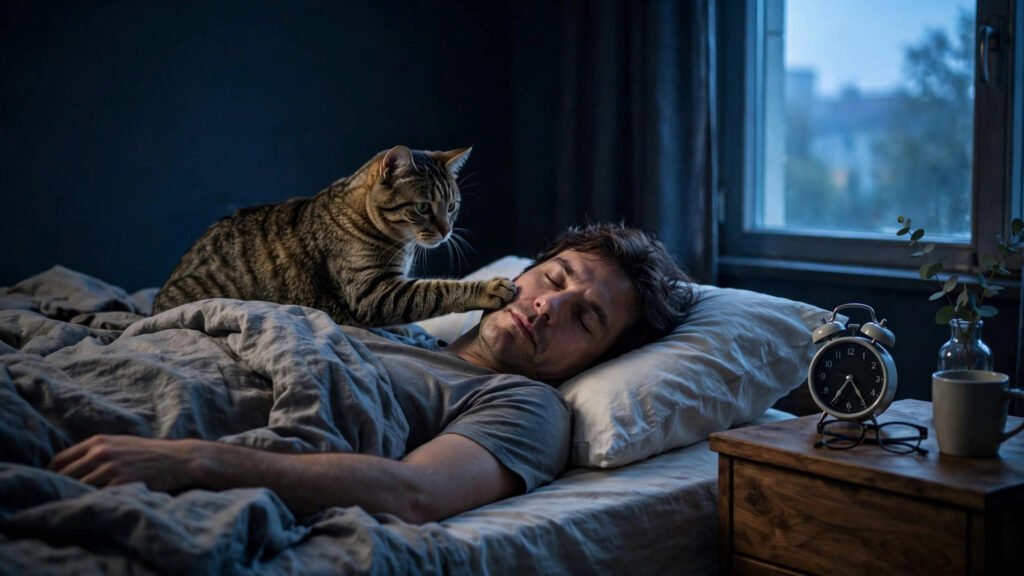
It’s 4 a.m. Paws on your face. Meowing in your ear. Something crashing in the hallway. Your cat has decided that dawn is breakfast time, playtime, and attention time — and you haven’t slept through the night in weeks. You’re not alone: pre-dawn wake-up calls are among the most common cat behavior complaints in America. Here’s the reassuring news — this is one of the most fixable cat problems there is. Your cat isn’t being spiteful; she’s following instincts and, crucially, a schedule you accidentally trained her to follow. Here’s how to retrain it.
Why Cats Do This: Biology Meets Accidental Training
Cats are crepuscular — biologically wired to be most active at dawn and dusk, prime hunting hours. A 4 a.m. energy burst is literally in her DNA. But biology alone doesn’t explain the face-patting: that’s learned behavior. Somewhere along the line, meowing at dawn got her fed, played with, or even just yelled at — and any response, including negative attention, rewards the behavior. She’s not waking you because she’s hungry at 4 a.m.; she’s waking you because it works.
Contributing factors pile on: a cat that’s bored and under-stimulated all day has energy to burn at night. A cat fed first thing when the owner gives up and gets out of bed learns that persistence pays. Inconsistent responses — sometimes you ignore her, sometimes you feed her — create the most persistent behavior of all, because intermittent reinforcement is the strongest kind. Understanding this changes the fix from “make the cat stop” to “make 4 a.m. wake-ups stop working.”
The Core Fix: Reset the Schedule
Move the big play session to the evening
This is the highest-impact change. A 15–20 minute interactive play session (wand toy, laser pointer followed by a tangible toy to “catch”) about an hour before your bedtime burns the dawn energy reserves. Follow it with a small meal or treat — the hunt-eat-groom-sleep sequence mirrors the natural feline cycle and promotes actual sleep. Owners who implement this one change often see improvement within a week.
Shift breakfast later with an automatic feeder
The automatic feeder is the secret weapon. Set it to dispense a small meal at 5:30 or 6 a.m. — whenever you want the day to start. The cat learns that food comes from the machine, not from harassing you, which breaks the meow-at-human-equals-breakfast association completely. Within two weeks, most cats redirect their dawn routine to the feeder and leave you alone. This single purchase ($40–$80) resolves more 4 a.m. cases than any other intervention.
Be boring at 4 a.m.
When she tries the old routine, give her nothing — no talking, no eye contact, no pushing her away (that’s attention), no getting up. The first few nights are the hardest: behavior typically gets worse before it gets better (an “extinction burst”) as she tries harder with the old strategy. Earplugs help you survive it. Most cats give up within 3–7 nights of total non-response — but one single 4 a.m. feeding resets the clock to zero. The ASPCA’s cat behavior solutions and PetMD’s guide to nighttime cat vocalization both confirm consistency is the deciding factor.
Set Up the Night for Success
Environmental tweaks support the retraining: close the bedroom door (with the cat’s needs met outside — water, litter, a comfortable sleeping spot). If closing the door isn’t an option, a white noise machine masks hallway theatrics. Leave quiet overnight enrichment: puzzle feeders, a cardboard box with holes, toys that don’t need you. And address daytime boredom — a cat that sleeps 20 hours from boredom will be wired at dawn; chronic poor sleep affects owners too, and fixing the cat’s schedule fixes yours. Interactive daytime play, window perches with bird views, and rotating toys reduce the overnight energy surplus that fuels 4 a.m. zoomies.
Multi-Cat Homes: When 4 A.M. Is a Group Project
Everything gets harder with multiple cats — including the dawn chorus. Cats in multi-cat homes often amplify each other’s nighttime activity: one cat starts the 4 a.m. zoomies and the rest join in, or competing cats take turns demanding early breakfast. The retraining principles still apply, but with adjustments: automatic feeders become essential rather than optional (one feeder per cat, placed apart to prevent guarding), and the evening play session needs to tire all of them — interactive group play with a wand toy, or sequential individual sessions for cats that don’t share well.
Resource competition is the hidden driver in many multi-cat dawn problems. Ensure enough litter boxes (one per cat plus one), separated feeding stations, and multiple water sources — a cat that’s anxious about resources is a cat that’s awake and patrolling at dawn. Feliway diffusers in sleeping areas reduce inter-cat tension that manifests as nighttime restlessness. And when retraining, remember that the extinction burst can synchronize — two cats escalating simultaneously is dramatically harder to sleep through than one. Earplugs, a closed bedroom door, and the knowledge that consistency across all cats (no 4 a.m. feeding for anyone, ever) will resolve it within a couple of weeks. The household that holds the line together sleeps together.
When 4 A.M. Wake-Ups Signal Something Medical
Sudden onset of nighttime restlessness in a previously quiet cat — especially a senior — warrants a vet check. Hyperthyroidism famously causes nighttime vocalization and restlessness in older cats. Cognitive decline (feline dementia) disrupts sleep-wake cycles. Hunger from an underlying condition, pain, or hypertension can all manifest as new nighttime behavior. The rule: if the 4 a.m. routine is new and your cat is over 10, vet first, behavior plan second. Similarly, improving your own sleep becomes much easier once the feline alarm clock is retired — but rule out medical causes before assuming it’s purely behavioral.
Conclusion
The 4 a.m. wake-up call is a trained behavior layered on crepuscular biology — and trained behaviors can be untrained. Evening play plus a late meal, an automatic feeder set for your preferred wake time, and a week of heroic boringness at 4 a.m. resolve the large majority of cases. Your cat isn’t broken or spiteful; she’s just running a program that used to work. Change what works, and she’ll change the program — and you’ll sleep through the night again.
Frequently Asked Questions
Why does my cat wake me up at the same time every night?
Cats are crepuscular (most active at dawn/dusk) and creatures of habit. Once 4 a.m. meowing successfully produced food or attention, it became a trained routine — she’s repeating what works.
Will an automatic feeder stop early morning meowing?
Usually yes — it’s the most effective single intervention. The cat learns food comes from the machine at a set time, breaking the association between harassing you and getting fed.
Should I ignore my cat when she wakes me up?
Yes — total non-response (no talking, touching, or eye contact) is essential. Any response, even negative, rewards the behavior. Expect an “extinction burst” of worse behavior for a few nights before it stops.
How long does it take to retrain a cat’s wake-up time?
Most cats adjust within 1-3 weeks of consistent new routines (evening play, automatic feeder, zero 4 a.m. response). Inconsistency — one family member giving in — restarts the process.
Could nighttime restlessness mean my cat is sick?
If it’s sudden onset in a senior cat, yes — hyperthyroidism, cognitive decline, hypertension, and pain can all cause new nighttime vocalization. Get a vet check before assuming it’s behavioral.