How Often Should Dogs See the Vet? The Checkup Schedule Guide
Your dog seems perfectly healthy — eating well, playing hard, no complaints. So do you really need to spend $200 on a vet visit just to be told “looks great”? It’s one of the most common questions American dog owners ask, and the honest answer is: yes, probably, and here’s why. Preventive veterinary care is one of those things that looks like a waste of money right up until the day it saves your dog’s life — or saves you $5,000. The right checkup schedule depends on your dog’s age and health, and it’s probably different from what you assume. Here’s the evidence-based guide.
The Standard Schedule by Life Stage
Puppies: every 3–4 weeks until 16 weeks
Puppyhood is the intensive phase: vaccine series (DHPP, rabies, plus bordetella/leptospirosis/Lyme based on your region and lifestyle), deworming, growth monitoring, and baseline establishment. These visits aren’t optional — maternal antibodies interfere with early vaccines, which is why the series repeats. Your vet also screens for congenital issues (heart murmurs, hernias, bite alignment) while they’re still correctable.
Healthy adults (1–7 years): once yearly
The annual exam is the cornerstone. A thorough nose-to-tail physical, vaccine boosters per schedule (many are now every 3 years after the initial series — ask, don’t assume annual everything), heartworm test, fecal test, and weight assessment. This is also when your vet updates the preventive plan for your region — tick-borne disease risk varies enormously across America, and protocols should match your actual exposure.
Seniors (7–8+ years, breed-dependent): twice yearly
Large and giant breeds age faster — many vets consider them senior at 6–7; small breeds at 10+. Senior visits add bloodwork (CBC, chemistry panel), urinalysis, blood pressure, and often chest x-rays or abdominal ultrasound for early detection. Dogs age roughly 5–7 “years” per calendar year in their senior phase — a lot can change in 12 months, which is why the interval halves. Catching kidney disease, thyroid issues, or a heart murmur six months earlier routinely changes the outcome.
What Actually Happens at a Wellness Exam (and Why It Matters)
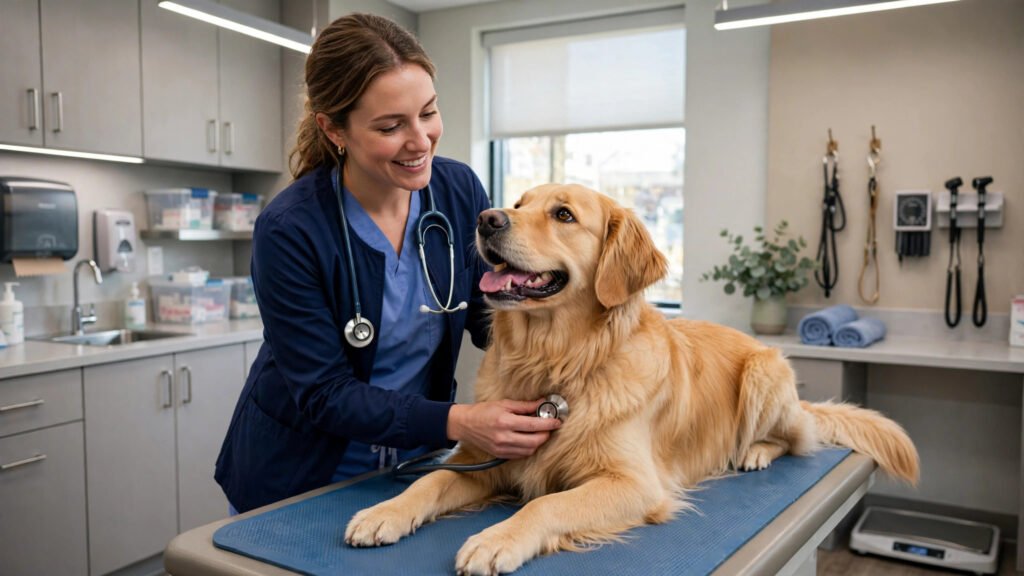
A good wellness exam is systematic: weight and body condition score (the obesity conversation happens here), eyes, ears, mouth and dental assessment (dental disease affects the majority of dogs over 3 and seeds bacteria into the bloodstream), heart and lung auscultation, abdominal palpation (masses, organ enlargement, pain), skin and coat, lymph nodes, joints and gait, and neurological basics. Then the lab work: heartworm antigen test (annual, even on prevention — no preventive is 100%), fecal float, and for seniors, the bloodwork panels that catch the silent killers — kidney, liver, thyroid, diabetes — before symptoms appear.
The value proposition: early detection is dramatically cheaper than late treatment. Managing early kidney disease costs a fraction of crisis hospitalization. A heart murmur caught at grade 2 gets monitored; caught at grade 5 with heart failure, it’s an emergency. The American Veterinary Medical Association preventive care guidelines emphasize this economics of early detection — the annual exam is the cheapest diagnostic tool in veterinary medicine. The AAHA’s preventive care guidelines set the clinical standards most US practices follow.
Vaccines: What’s Actually Needed
Core vaccines (recommended for all dogs): rabies (legally required in nearly every state), DHPP (distemper, hepatitis, parainfluenza, parvovirus). Non-core, based on lifestyle and region: bordetella (boarding, daycare, dog parks), leptospirosis (wildlife exposure, standing water — increasingly recommended broadly), Lyme (tick-heavy regions), canine influenza (social dogs in outbreak areas). After the initial series, many core vaccines are now boostered every 3 years — but rabies intervals follow state law, and non-core vaccines are typically annual. Ask your vet for a written vaccine schedule rather than defaulting to “whatever’s due.” And keep records — boarding facilities, groomers, and seasonal illness prevention planning all depend on knowing exactly what’s current.
Between Visits: Your At-Home Monitoring
The exam is annual; your observation is daily. Monthly: weigh your dog (weight trends are diagnostic), run hands over the body for new lumps (note size in millimeters — “pea-sized” is trackable), check ears, teeth, and skin. Know the baselines: normal appetite, water intake, energy, stool. Call between scheduled visits for: appetite loss beyond 24 hours, vomiting/diarrhea persisting past a day, lameness, new lumps growing quickly, coughing, or behavior changes. The principle mirrors human care — knowing when symptoms need professional attention is about not waiting for the annual physical when something’s actively wrong.
The Cost Question: Budgeting for Preventive Care
Realistic 2026 numbers: annual wellness exam $75–$150, core vaccines $75–$150, heartworm test $45–$65, fecal $40–$60, preventatives (flea/tick/heartworm) $200–$400/year, senior bloodwork $200–$400. Total: roughly $400–$800/year for a healthy adult, $700–$1,200 for a senior. Pet insurance wellness add-ons rarely beat self-budgeting for routine care — but accident-and-illness coverage pairs well with diligent preventive visits. Many vets offer wellness plans spreading costs monthly. The math that matters: one prevented emergency ($3,000–$7,000) funds a decade of checkups.
Finding the Right Vet (It Matters More Than You Think)
The checkup schedule only works if the vet is worth visiting. A great vet explains rather than dictates, welcomes your questions, handles your dog with patience (watch how they interact — a vet that rushes a fearful dog is a red flag), and discusses costs transparently before proceeding. Practical criteria: AAHA accreditation (a voluntary standards program — accredited hospitals meet higher benchmarks), Fear Free certification (low-stress handling techniques), convenient location (you’ll skip visits that require a 45-minute drive), and emergency coverage clarity (who handles your dog at 2 a.m.?).
Don’t stay with a vet you dread out of inertia. It’s entirely normal to “interview” practices — many offer meet-and-greet visits. Ask about their vaccine philosophy (do they follow the 3-year protocols or push annual everything?), their dental program, and how they handle estimate approvals. The annual exam is a relationship, not a transaction: the vet who knows your dog’s baselines across years catches subtle changes a stranger would miss. That continuity is the hidden value of the checkup schedule — the exam matters, but the vet who performs it matters more.
Conclusion
Take your puppy in every 3–4 weeks until 16 weeks, your healthy adult annually, and your senior twice a year with bloodwork. Keep vaccines current per your vet’s written schedule, monitor weight and lumps monthly at home, and never wait for the annual exam when something’s wrong now. Preventive care isn’t an upsell — it’s the highest-value money in all of pet ownership, buying early detection at a fraction of crisis prices and, more often than owners realize, buying years.
Frequently Asked Questions
Does my dog really need a vet visit every year?
Yes — the annual exam catches silent problems (early kidney disease, heart murmurs, dental disease, lumps) when they’re cheapest and most treatable. Skipping years means problems surface as emergencies.
How often do senior dogs need checkups?
Twice yearly with bloodwork. Senior dogs age fast — a lot changes in 12 months — and early detection of age-related disease dramatically improves outcomes.
Are annual vaccines necessary?
Many core vaccines are now every 3 years after the initial series, but rabies follows state law and non-core vaccines (bordetella, lepto, Lyme) are typically annual. Get a written schedule from your vet.
How much does a routine vet checkup cost?
The exam itself runs $75-$150; with vaccines, heartworm test, and preventatives, budget $400-$800/year for a healthy adult dog and $700-$1,200 for seniors with bloodwork.
What should I monitor at home between visits?
Monthly weight, new lumps (measure them), appetite/water/energy baselines, dental condition, and skin/coat changes. Call promptly for anything that deviates — don’t wait for the annual exam.