How to Divide Perennials Without Damaging Roots
That glorious clump of hostas has become three clumps fighting for space. The daylilies are a tangled mat blooming half-heartedly. Dividing perennials — splitting one overgrown plant into several — is free plants, rejuvenated blooms, and garden generosity all in one. But the fear is real: hack into the root ball wrong and you’ve killed a plant you loved. Here’s the truth: perennials evolved to be divided. Their root systems expect disturbance, and a properly divided plant typically outperforms its parent within a season. Here’s the method that keeps every division alive.
When and What to Divide
Timing: divide spring-blooming perennials in fall, and fall-blooming perennials in spring — the rule is “divide when not blooming,” giving roots a full season to establish before their energy goes to flowers. Cool, overcast days are ideal; hot sun stresses exposed roots. Early spring (as new growth emerges, 2–4 inches tall) is the most forgiving window for most plants — you can see what you’re doing and the plant rebounds fast.
Signs a perennial needs dividing: the center is dead or hollow while the edges thrive (the classic “donut”), blooms have diminished in size or number, the clump flops outward, or it’s crowding neighbors. Most perennials want dividing every 3–5 years; some (hostas, daylilies) tolerate longer, while aggressive spreaders (bee balm, mint family) need it every 2–3 years to stay civilized.
Don’t divide: taprooted plants that resent disturbance — butterfly weed, baby’s breath, lavender, Russian sage, and most ornamental grasses prefer to stay put (grasses can be divided but need brutal commitment). Also skip plants currently in full bloom or under stress (drought, disease). When in doubt, the Old Farmer’s Almanac plant guides note divisibility per species — check before you dig.
Preparation: The Day Before
Water the plant deeply 24 hours before dividing — hydrated roots are flexible roots, and moist soil holds together instead of crumbling away from them. Prepare the new homes first: dig the receiving holes, amend with compost, and have them ready — divisions should spend minutes, not hours, out of the ground. Gather tools: a sharp spade (flat-blade, not pointed), a garden fork, a hori-hori knife for smaller plants, and a tarp to work on (keeps roots shaded and soil contained).
Cut back the foliage to 4–6 inches before digging (for spring division) — this reduces transpiration stress on the roots and lets you see the crown structure. The University of Minnesota Extension’s perennial-division guides give timing charts by species. It looks alarming; the plant will regrow foliage rapidly. For fall division, foliage is already dying back — just clear it. Sharp tools matter enormously: clean cuts heal, ragged tears invite rot. This preparation takes 20 minutes and determines 80 percent of your success.
The Division: Three Methods by Root Type
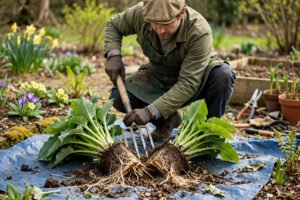
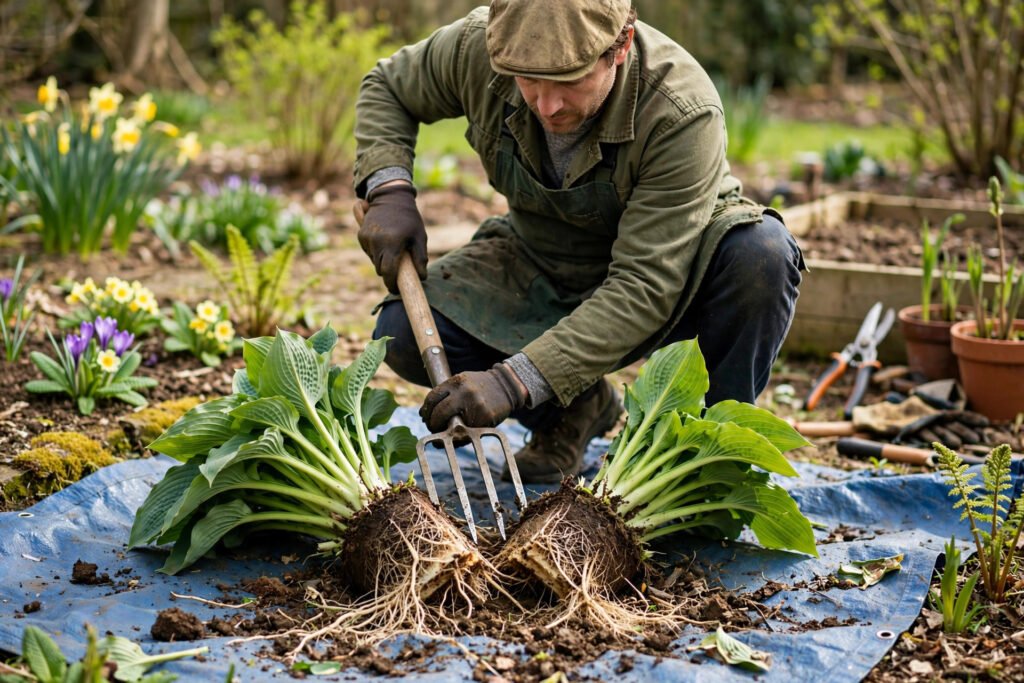
Method 1 — Fork-pry (fibrous roots: hostas, daylilies, ornamental grasses): dig around the entire clump, 6–8 inches out from the crown, and lift the whole root ball. Insert two garden forks back-to-back into the center and lever them apart — the roots separate along natural fault lines with minimal tearing. For huge clumps, a sharp spade chop into quarters works; each quarter should have 3–5 growing points (“eyes” or fans). This looks violent and feels wrong — it’s exactly right. Fibrous-rooted perennials are astonishingly tough.
Method 2 — Knife-cut (dense crowns: asters, mums, bee balm): lift the clump and cut decisively through the crown with a sharp spade or hori-hori, ensuring each division has both roots and 2–3 shoots. Discard the dead center (the donut hole) — it’s exhausted; keep only the vigorous outer portions. Think of it as editing: you’re keeping the best chapters and deleting the filler.
Method 3 — Tease apart (delicate roots: heuchera, primroses, bleeding heart): soak the root ball in a bucket of water for 20 minutes, then gently tease apart with your fingers or a hand fork. These plants have finer roots worth preserving — patience here pays in faster establishment. Never divide these with a spade chop; the crown damage sets them back severely.
Replanting: The Critical Hour
Plant divisions immediately at the same depth they grew before — the crown (where roots meet shoots) should sit exactly at soil level. Too deep rots crowns; too shallow exposes roots. This is the most common replanting error and the easiest to avoid: look for the soil line on the original plant and match it.
Backfill with a 50/50 mix of native soil and compost — pure compost in the hole creates a “pot effect” where roots refuse to venture into surrounding soil. Water deeply immediately (a full soaking, not a sprinkle), then mulch 2 inches (not touching crowns). For the first two weeks, water every 2–3 days if rain doesn’t — divisions have reduced root mass supporting full foliage demand, and consistent moisture bridges the gap until new roots grow. A diluted liquid seaweed feed at planting reduces transplant shock measurably. Divisions in raised beds with loose, rich soil establish fastest — the friable texture lets new roots penetrate easily, which is why divided plants often outperform their parents within one season.
Aftercare and Troubleshooting
Expect drama: divisions often wilt dramatically for 2–3 days (transplant shock), then perk up. Don’t panic-water into swamp conditions — consistent moisture, not flooding. If foliage collapses entirely, cut it back harder — the roots are alive and will push new growth; the plant is triaging. Hold off on heavy fertilizing for 3–4 weeks; the seaweed feed at planting suffices until roots establish.
Failures and causes: division died within a week — usually planted too deep, left exposed to sun/wind too long, or divided during heat stress. Division survives but doesn’t grow — root-bound divisions need their circling roots scored; also check planting depth. One division thrives, others languish — normal variance; the strugglers often catch up by next season. Keep records of what you divided and when — forgiving beginner plants are ideal first-division practice before you tackle prized specimens, and a simple garden journal prevents the “did I divide this last year?” confusion.
Conclusion
Dividing perennials without damaging roots is straightforward: time it for the off-bloom season, water deeply the day before, match the method to the root type (fork-pry for fibrous, knife-cut for dense crowns, tease for delicate), replant immediately at the original depth, and water consistently for two weeks. The violence of the process alarms every first-timer — and every first-timer is amazed when the divisions outperform the parent. Your garden doubles for free; your gardening friends get gifts; the plants get rejuvenated. Everybody wins.
Frequently Asked Questions
Can you divide perennials in summer?
It’s possible but stressful — heat plus transplant shock is a hard combination. If you must, do it on a cool overcast day, cut foliage back hard, water religiously, and shade new divisions for a week. Spring and fall remain far more forgiving.
How small can divisions be?
Each division needs roots plus at least 2–3 growing points (shoots/eyes/fans). Smaller divisions survive but take an extra season to reach blooming size. When in doubt, make fewer, larger divisions — generosity with size pays in establishment speed.
Do all perennials need dividing?
No — taprooted plants (butterfly weed, lavender, baby’s breath, Russian sage) resent disturbance and should be left alone. Most fibrous-rooted perennials benefit every 3–5 years. Check species-specific guidance before digging up anything precious.
Why did my divided perennial die?
The usual suspects: planted too deep (crown rot), left exposed too long before replanting, divided during heat or bloom stress, or underwatered in the first two weeks. Correct depth, immediate replanting, and consistent moisture prevent the vast majority of failures.