
Which Charger Is Safe for Your Phone? (Stop Guessing)
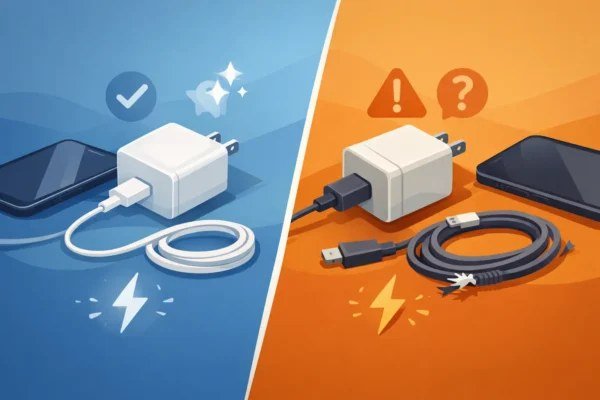
That gas-station charger. The ancient brick from 2015. Your laptop’s USB-C charger. Are any of them safe? Figuring out which charger is safe to use with your phone matters more than most people think — bad chargers are a genuine fire risk, not just a slow-charge annoyance.
The good news: modern phones are smart about protecting themselves. The bad news: ‘smart’ has limits. Here’s how to choose safely.
The short answer: any charger from a reputable brand with UL/CE certification is safe — your phone only draws the power it needs, so a higher-wattage quality charger won’t hurt it. Avoid no-name chargers without certifications; they’re the fire risk. Match the fast-charging standard (USB-PD for iPhone/Pixel, SuperVOOC for OnePlus, etc.) for full speed.
The One Rule: Your Phone Controls the Power
Here’s what surprises people: the phone decides how much power to take, not the charger. Plugging a phone that charges at 20W into a quality 65W laptop charger is completely safe — the phone simply draws its 20W. Wattage on the charger is a maximum, not a constant blast. This is why you can share chargers across devices without worry, as long as the charger itself is well-made.
What actually matters is the charging standard handshake: USB Power Delivery (USB-PD) is the universal standard iPhones (15+), Pixels, and most Android phones use. Samsung uses PD plus its own Super Fast Charging; OnePlus uses SuperVOOC; Motorola uses TurboPower. A generic PD charger safely fast-charges all of them at standard PD speeds — you only need the brand-specific charger for the absolute fastest proprietary speeds.
How to Spot a Dangerous Charger
The fire-risk chargers share traits: no-name brands sold in multi-packs for suspiciously little, no UL/ETL/CE certification marks (or obviously fake ones), extreme lightness (quality chargers have heft from proper components), and loose-fitting plugs. Counterfeit Apple and Samsung chargers are rampant on marketplaces — if the price is half of retail, assume it’s fake.
Real consequences: cheap chargers can deliver unstable voltage that slowly damages your battery, overheats, or in rare cases catches fire — the US Consumer Product Safety Commission recalls dangerous chargers regularly. This isn’t fear-mongering; it’s the one phone accessory where brand genuinely matters for safety. Anker, Belkin, Apple, Samsung, Google, and UGREEN are all safe bets in the $15–$30 range.
- Safe: UL/ETL/CE certified, reputable brand, solid weight, snug plug fit
- Risky: no-name multipacks, missing/fake certifications, suspiciously cheap
- Higher wattage is fine — your phone only draws what it needs
- USB-PD is the universal fast-charging standard for most phones
- Replace any charger that’s hot, buzzing, discolored, or smells odd
Cables Matter Too
A great charger with a junk cable still charges slowly — or not at all. For USB-C fast charging, the cable must support the wattage: look for 60W or 100W ratings on USB-C cables. Frayed cables aren’t just slow; damaged cables can short and damage the charging port or worse. Replace any cable with exposed wiring immediately — a $10 cable isn’t worth a $1,000 phone.
For iPhones with Lightning (14 and older), MFi certification (‘Made for iPhone’) is the mark of a safe third-party cable — uncertified Lightning cables trigger warnings and can damage the port. USB-C iPhones (15+) use standard PD cables, no special certification needed. When in doubt, the cable that came with the phone is always safe.
Charging Habits That Protect Your Battery
Modern batteries degrade mainly from heat and time spent at 100%. The 80% limit features (iPhone’s Optimized Charge Limit, Android’s Adaptive Charging / Protect Battery) genuinely extend battery life — turn them on. Overnight charging is fine with these enabled; without them, it’s the biggest source of unnecessary battery wear.
Wireless charging generates more heat than wired, so it’s slightly harder on long-term battery health — convenient, but don’t make it your only method if you keep phones for years. And if your phone gets hot while charging, unplug it and check: a hot phone plus a cheap charger is the combination to worry about. A quality charger and a warm (not hot) phone is normal.
How Do I Know Which Charger Is Safe to Use With My Phone While Traveling?
Travel multiplies charger risk: unfamiliar outlets, voltage differences, and tempting cheap chargers in every market stall. The essentials: a quality GaN charger (65W from Anker, UGREEN, or Belkin, $30–$45) handles phone, tablet, and laptop from one brick — one charger instead of three. GaN chargers are smaller, cooler, and more efficient than old silicon ones; there’s no reason to buy non-GaN in 2026.
For international travel, you need plug adapters (not voltage converters — modern phone chargers are universal 100–240V, so only the plug shape changes). Get a compact universal adapter or a set of regional plugs; avoid the giant ‘all-in-one’ cubes with loose connections. And never buy chargers from street vendors abroad — counterfeit chargers are rampant in tourist markets, and the certification marks are faked convincingly. Pack your charger from home; it’s the one travel accessory worth the space.
Hotel USB ports deserve caution: they’re convenient but slow, sometimes damaged, and theoretically vulnerable to ‘juice jacking’ (malware via USB). The actual risk is low, but a $10 USB data blocker (a tiny adapter that passes power only) eliminates it entirely. Or just use your own charger in the wall outlet — simplest and safest.
Related reading: why your phone battery drains so fast overnight · how to turn off background apps to save phone battery
The Bottom Line
Any certified charger from a reputable brand is safe — your phone limits the power it draws, so higher wattage is fine. USB-PD is the universal fast standard. Avoid no-name uncertified chargers (real fire risk), replace frayed cables, and enable your phone’s 80% charge limit to protect long-term battery health. When a charger runs hot or smells odd, retire it immediately.
Sources: UL: certified charger safety · US CPSC: charger recalls






