How to Stop Weeds Without Harsh Chemicals
Weeds are the unglamorous truth of gardening: whatever you plant, nature plants ten competitors. The chemical shortcut — glyphosate and its cousins — works, but growing numbers of gardeners want it nowhere near their vegetables, kids, pets, or pollinators. The good news: the most effective weed control was never chemical. It’s ecological — understanding why weeds thrive and removing their advantages. A garden managed with mulch, timing, and smart tactics stays cleaner than a sprayed one, with soil that gets better every year instead of worse. Here’s the complete chemical-free system.
Think Like a Weed (Know Your Enemy)
Weeds aren’t evil; they’re pioneer plants evolved to colonize bare disturbed soil fast. Every weed-control tactic exploits this: they need light to germinate (most weed seeds won’t sprout in darkness), they need disturbed soil (tilling brings buried seeds to the surface — a single tilling can expose thousands), and they’re racing your plants to resources. Your strategy: deny light, minimize disturbance, and give your plants the head start.
Identify your top offenders, because tactics differ. Annual weeds (crabgrass, chickweed, purslane) live one season and spread by seed — prevent seeding and you break the cycle in a year or two. Perennial weeds (dandelions, bindweed, quackgrass) return from roots — they require root removal or exhaustion, and cutting them casually just prunes them. Creeping spreaders (creeping Charlie, Bermuda grass) advance by runners — they need physical barriers. Walk your garden, learn the 3–5 dominant weeds, and target tactics accordingly. The Old Farmer’s Almanac weed identification guides are excellent for this.
Mulch: The 80/20 of Weed Control
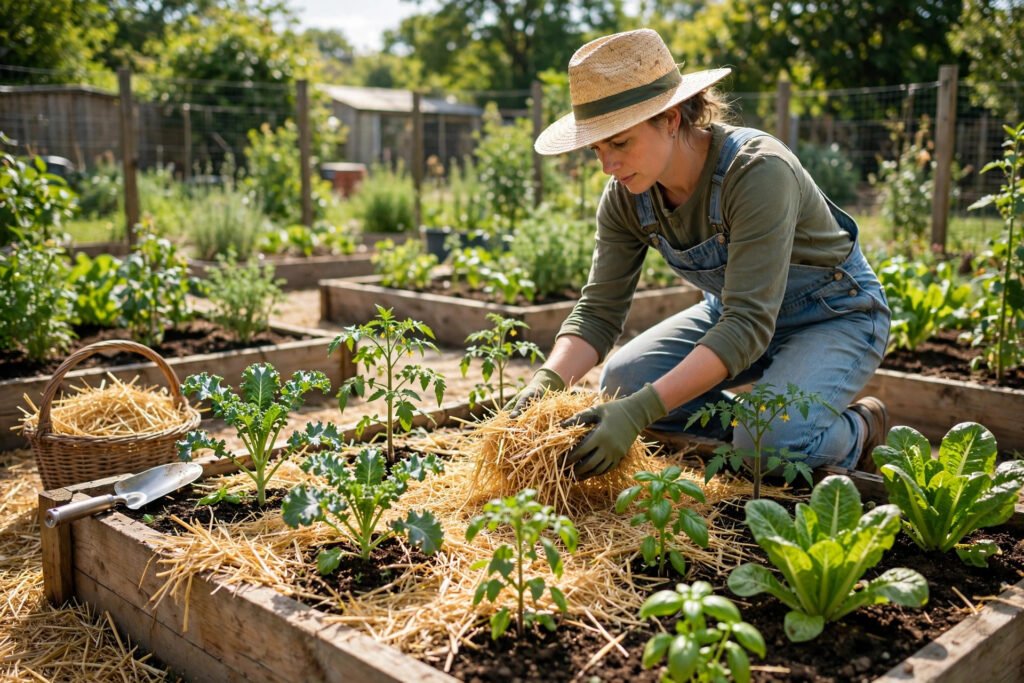
If you do one thing, mulch. A 3–4 inch layer of organic mulch (wood chips, straw, shredded leaves, bark) blocks the light weed seeds need, and it suppresses 90%+ of annual weeds while feeding soil as it decomposes. This is the single highest-ROI garden task in existence — a weekend of mulching saves a season of weeding. For vegetable gardens, straw or shredded leaves; for paths and perennials, wood chips (arborist chips are often free from tree services).
Technique matters: mulch after weeding and watering (don’t mulch over established weeds — they’ll punch through), keep mulch off plant stems (crown rot), and replenish yearly as it decomposes. For new beds over lawn or weeds, use sheet mulching (lasagna gardening): cardboard directly over the area, soaked, topped with 4–6 inches of compost and mulch — in 2–3 months you have plantable bed with the weeds smothered underneath, no digging, no chemicals. This method is transformative for building new raised beds without the backbreaking sod removal.
Timing Tactics: Weed Before They Weed You
The stale seedbed: prepare soil 2–3 weeks before planting, let the first flush of weeds germinate, then hoe them off shallowly (disturbing only the top inch) and plant into clean soil. You’ve exhausted the surface seed bank’s first wave — the weeds that would have competed with your seedlings are dead. Market gardeners swear by this; home gardeners rarely try it.
Hoe when small: a stirrup (hula) hoe through dry soil on a sunny day kills seedling weeds in minutes — they desiccate on the surface. The rule: never let weeds set seed, and kill them young. Five minutes weekly with a hoe beats five hours monthly of hand-pulling monsters. Weed after rain: perennial weeds with taproots (dandelions) pull cleanly from moist soil — dry soil snaps roots and they regrow. Get the whole root or don’t bother; a dandelion’s taproot fragment regenerates cheerfully.
Flame weeding: a propane garden torch ($50–$80) wilts seedling weeds in paths and bed edges in seconds — you’re not incinerating, just rupturing cells (a slow pass that wilts is correct; charring wastes fuel). Extremely satisfying, chemical-free, and perfect for gravel paths where mulch is impractical. Keep water handy and avoid during burn bans, obviously.
Barriers and Smothering for Tough Cases
For perennial invaders, escalate physically. Deep edging: metal or plastic edging sunk 6–8 inches deep stops creeping grasses from invading beds laterally — the number-one defense against Bermuda grass. Solarization: clear plastic over moist soil for 4–6 weeks in summer heat kills weeds, seeds, and soil pathogens to several inches deep — excellent for resetting a weedy area before planting. Smothering: tarps or cardboard over aggressive patches for a full season exhausts even bindweed and quackgrass (their roots starve without light).
Competitive planting: nature abhors bare soil, so don’t leave any. Dense plantings, living mulches (low clover or creeping thyme between plants), and cover crops in off-seasons (crimson clover, winter rye) outcompete weeds while improving soil. A garden with no bare soil has no weed problem — the weeds simply have nowhere to establish. Even balcony gardeners benefit: full containers with trailing plants leave no surface for weeds, and mulch works in pots too.
Targeted Organic Options (When You Need More)
For spot treatment, several non-synthetic options work: horticultural vinegar (20% acetic acid) burns top growth on young weeds — effective, but it’s a non-selective acid requiring gloves and eye protection (this is not kitchen vinegar, which is too weak). Boiling water kills weeds in cracks and paths instantly — free and satisfying. Corn gluten meal prevents seed germination (pre-emergent, not a killer of existing weeds) — useful on lawns in spring.
What about the “natural” recipes (vinegar-salt-dish soap)? They kill top growth but salt sterilizes soil — never use salt where you’ll ever plant again. And be honest about trade-offs: these are contact killers, not systemic — perennial weeds regrow from roots, requiring repeat applications. They’re tools for edges and paths, not replacements for mulch and timing in beds. The EPA maintains updated guidance on minimum-risk pest control options worth consulting.
Conclusion
Stopping weeds without harsh chemicals is a system, not a product: mulch everything 3–4 inches deep, use the stale seedbed before planting, hoe seedlings weekly before they establish, pull perennials by the whole root after rain, edge against creepers, and keep no soil bare. The first season takes effort; every season after gets easier as the seed bank depletes and your soil improves. Chemical-free isn’t the harder path — it’s the path where the garden gets better instead of just staying the same.
Frequently Asked Questions
What kills weeds permanently without chemicals?
Nothing kills all weeds permanently — but the combination of deep mulch, preventing seed set, and depleting the seed bank reduces weed pressure 90%+ within 2–3 seasons. Solarization and season-long smothering reset badly infested areas. Permanence comes from system, not product.
Is vinegar a safe alternative to Roundup?
Horticultural (20%) vinegar effectively burns young weeds’ top growth and breaks down quickly, making it safer environmentally than synthetic herbicides. But it’s a strong acid requiring protective gear, kills any plant it touches, and doesn’t kill perennial roots. Use for paths and spot treatment, not as a garden-wide solution.
How do I get rid of bindweed without herbicides?
Persistence: smother with tarps for a full growing season, or repeatedly cut at ground level every 7–10 days to exhaust root reserves (takes a full season or two). Never till bindweed — every root fragment becomes a new plant. Deep mulch plus vigilant cutting eventually wins.
Does mulch really prevent weeds?
Yes — 3–4 inches of organic mulch blocks the light most weed seeds need, suppressing 90%+ of annual weeds. It fails only when applied too thin, over existing established weeds, or allowed to decompose without replenishing. It’s the highest-ROI weed control available at any price.